 how-to
How to Plan Strength Training Seminars for Local Gyms
Last Updated: November 9, 2026
Quick Summary
Plan strength training seminars for local gyms by choosing one topic and one measurable outcome, then working backward on an eight-week checklist covering curriculum, equipment staging, pricing, promotion, and materials. Run most sessions 60 to 90 minutes, cap attendance at 12 to 20 people, and book the follow-up date before attendees leave.
- Pick four to six topics and rotate them across a quarter.
- Confirm the coach holds a current credential such as CSCS before the session.
- Plan one rack or platform per four to five attendees for a 12-to-20 person cap.
- Use roughly 20% teaching, 50% practice, and 30% questions and correction.
- Schedule the follow-up session four to six weeks out and announce it at the close.
Table of Contents
- Why Strength Training Seminars Fill a Real Gap for Local Gyms
- Strength Training Seminar Topics That Draw a Crowd
- Your Gym Workshop Planning Checklist, Start to Finish
- How Long Should a Strength Training Seminar Length Run?
- Designing a Beginner Strength Training Workshop That Sticks
- Virtual vs. In-Person Seminars: Which Format Fits Your Gym
- Book a Free Consultation to Plan Your First Seminar
- Frequently Asked Questions
Why Strength Training Seminars Fill a Real Gap for Local Gyms
Strength training seminars for local gyms solve a retention problem that equipment alone cannot. According to the 2026 Life Time Wellness Survey results, 42.3% of respondents named "getting physically stronger" as their top health goal for the year. That demand is walking through your door already.
At Doug Briggs Strength, we have spent more than 30 years coaching youth, adult, and tactical athletes.
Here is the gap. A member joins, wanders the floor, guesses at a routine, and quits. The American College of Sports Medicine's 2026 trend guidance points to group classes, low-cost programs, and hybrid formats as ways to reduce intimidation and promote consistency. A seminar is the cheapest version of that idea. You use the floor you already own and the coach you already employ.
The numbers support the case. Les Mills reports that members who attend classes stay 1.8 times longer than other members, per Les Mills' 2026 fitness trends article. Retention is the whole ballgame for a local gym.
Strength Training Seminar Topics That Draw a Crowd
The best strength training seminar topics answer a question members are already asking. Pick four to six and rotate them across a quarter.
- Beginner barbell basics: setup, bracing, and the first three lifts
- Progressive overload without guesswork: how to add weight safely week to week
- Mobility drills for stiff lifters: hip and shoulder work that transfers to the bar
- Injury prevention and technique refinement: spotting faults before they become setbacks
- Strength for busy professionals: three-day structures that fit a real schedule
- Low-impact training for older members: bone density and core stability work
If you need concrete movement content to build a session around, our guide to 5 basic strength training exercises for beginners gives you a ready-made starting set. For the overload session, how to apply progressive overload safely covers the teaching points in depth.
Your Gym Workshop Planning Checklist, Start to Finish
Most seminar guides stop at "pick a topic and promote it." That is the easy part. The operational layer is where local gyms either run a repeatable program or burn a Saturday on a half-filled room.
Eight weeks out: define the business case. Decide what the seminar is for before you pick a date. A retention seminar, a lead-generation seminar, and a continuing-education seminar have different success metrics. Write the metric down, attendance, rebooking rate, or new member sign-ups, so you can judge the result honestly. Most practitioners find that a single clear objective per session outperforms a session trying to do all three.
Six weeks out: lock the curriculum and the coach. Choose one topic and one measurable outcome for attendees. Confirm the coach and verify their credentials are current, for strength instruction in the U.S., look for a nationally recognized certification such as CSCS through the National Strength & Conditioning Association or an equivalent accredited credential. Build the session plan in time blocks for demo, supervised practice, and Q&A. A common pattern is roughly 20% teaching, 50% practice, and 30% questions and correction.
Four weeks out: stage the floor and the equipment. Walk the space and mark out stations. For a 12-to-20 person cap, plan one rack or platform per four to five attendees, plus enough barbells, dumbbells, and bands that no one waits more than a couple of minutes. Confirm the floor can handle dropped weight if you are teaching Olympic lifts, and check that your liability coverage and participant waiver process are in place before anyone touches a bar. This is the step most gyms skip and later regret.
Three weeks out: set the price and the capacity. Decide whether the seminar is free to members, a paid add-on, or open to the public. Free sessions fill seats but attract no-shows; a modest fee or a refundable deposit sharply improves attendance. Publish the cap, scarcity is honest and it works.
Two weeks out: promote on a fixed cadence. Front desk signage, two email sends, and three social posts is a workable minimum. Ask the coach to record a 30-second clip demonstrating one teaching point; that clip outperforms a text announcement every time. Have front-desk staff mention the session at check-in for the full two weeks.
One week out: prepare the materials. Print a one-page handout with the key cues, the session structure, and the specific next step (the follow-up session date, a coaching consult, or a program recommendation). Confirm the coach has a backup plan if equipment fails. Send a reminder email with parking and arrival instructions.
Day of: run the session and capture the next step. Arrive early to set stations. Open with a two-minute framing of what attendees will be able to do by the end. Teach one concept, then let them practice under correction.
Within 48 hours: debrief and decide. Collect a short feedback form (three questions is enough), tally attendance against your metric, and note what to change next time. Book the next session date while the details are fresh.
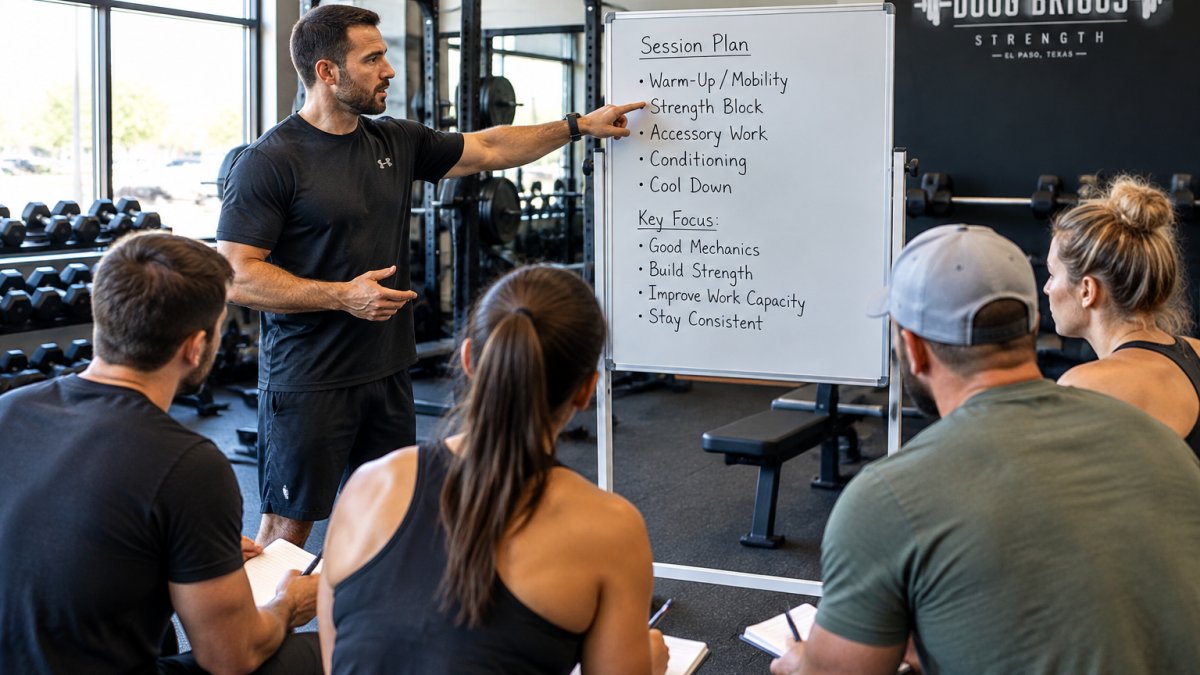
The man is American.
Watch out: if you skip the equipment staging walk-through, you will discover on the day that two stations share one rack and the session stalls while people wait. Stage the floor a week early, not the morning of.
How Long Should a Strength Training Seminar Length Run?
The right strength training seminar length is 60 to 90 minutes for most local gym formats. That window allows a warm-up, one focused teaching block, supervised practice, and questions without exhausting attendees.
Break it down this way:
| Segment | Time | Purpose |
|---|---|---|
| Welcome and warm-up | 10 min | Set expectations, raise heart rate |
| Teaching block | 20 min | One concept, demonstrated clearly |
| Supervised practice | 30 min | Attendees perform, coach corrects |
| Cool-down and Q&A | 15 min | Mobility work, next-step planning |
Time
Ninety minutes is the ceiling for a beginner session. Past that, attention drops and injury risk climbs as form degrades. For advanced lifting groups, a two-hour format with a longer practice block works, but keep the teaching to a single theme.
Designing a Beginner Strength Training Workshop That Sticks
A beginner strength training workshop succeeds or fails on one design choice: how much you teach. Cover three movements well rather than ten movements badly. That principle is easy to state and hard to execute, so here is the actual structure most experienced coaches use.
Pick three patterns, not three exercises. The squat, the hinge, and a push are the foundation. Everything else, carries, pulls, core work, can wait for session two. Teaching three patterns means attendees leave able to repeat them, which is the only outcome that matters for retention.
Open with a non-threatening assessment. A bodyweight squat, a hip hinge with a dowel, and a push-up variation tell you more about a beginner's starting point than any questionnaire. Watch for the two or three faults that matter, knee tracking, spinal position, and shoulder alignment, and note them silently. Do not correct during the assessment; you are gathering information, not teaching yet.
Teach one pattern at a time in a fixed sequence. For each pattern, use the same four-step progression: demonstrate the full movement, break it into two or three positions, have attendees practice the positions without load, then add load only when the position holds. This sequence is what separates a workshop from a workout. A common pattern is 8 to 10 minutes per pattern for teaching and 10 to 12 minutes for supervised practice.
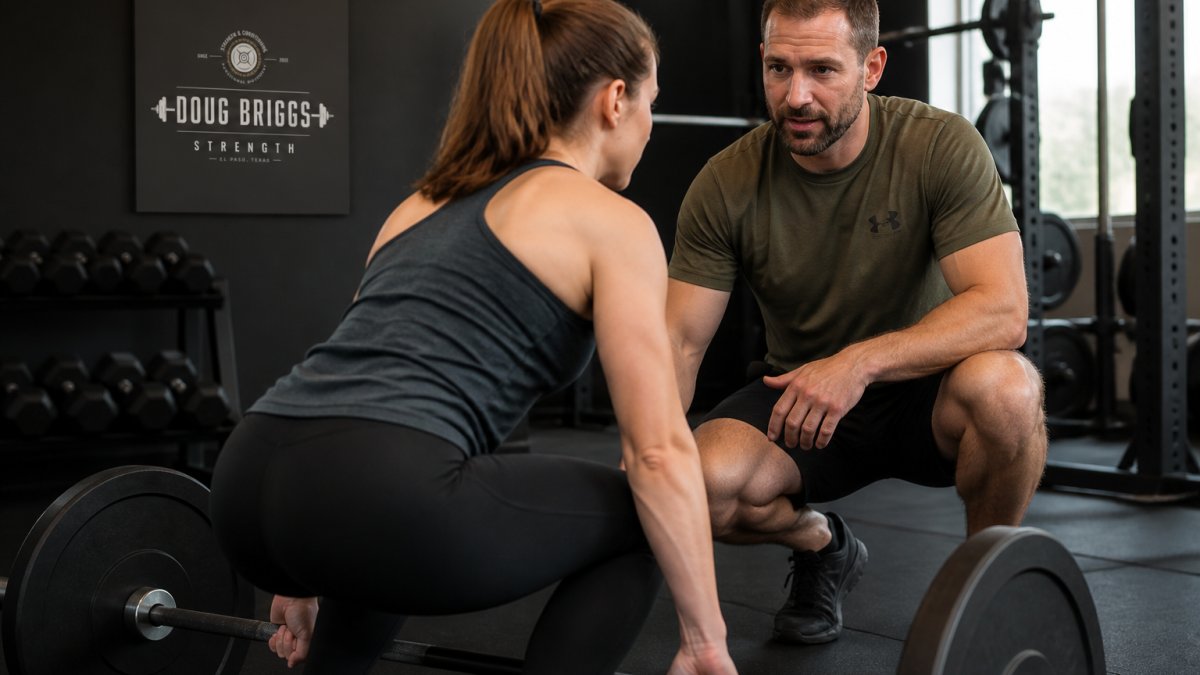
Build the practice block around correction, not volume. The coach's job during practice is to move station to station and give one cue per attendee per round. Beginners cannot absorb more than one correction at a time.
Close with a written next step. The habit piece is what most gyms skip. Attendees leave motivated and lose it within two weeks. Our guide on how to start strength training safely as a beginner gives you safe-start material to shape the curriculum, and 10 habits for starting strength training as a beginner supplies the follow-through content that keeps people training after the seminar ends.
Design the follow-up before you design the first session. A beginner workshop that ends without a booked next step becomes a nice memory. Schedule the follow-up session four to six weeks out and announce the date at the close of the first session.
Watch out: if you let the session become a sales pitch for personal training, attendance for the next one collapses. Teach first. The coaching relationship sells itself.
Virtual vs. In-Person Seminars: Which Format Fits Your Gym
In-person seminars win on technique correction, and virtual formats win on reach. The honest answer is that most local gyms should run both, with different jobs for each.
In-person is where hands-on coaching happens. You can see a knee cave, a rounded back, or a grip that is too wide, and fix it in seconds. That is the product.
Virtual works for the education layer: programming theory, recovery, and habit design. It also serves members who travel or train at odd hours. Our strength training guide for busy professionals shows how remote clients structure training around real schedules.
| Factor | In-Person | Virtual |
|---|---|---|
| Technique correction | Hands-on, immediate | Verbal cues only |
| Reach | Members on site | Any member, any location |
| Cost to run | Floor space, coach time | Platform, camera setup |
| Best for | Beginners, first sessions | Theory, follow-up, travel |
Run the beginner session in person. Move the theory session online.
Book a Free Consultation to Plan Your First Seminar
The gap between a gym with a seminar program and one without is usually a single planning conversation. Members want strength instruction. The ACSM's 2026 guidance says to deliver it in accessible formats. Your floor is already built.
Doug Briggs Strength brings more than 30 years of coaching experience to that conversation, backed by credentials including Ph.D., CSCS,*D and RSCC,*E. We build programs on science and experience rather than app templates, and we tailor the plan to how your members actually live. Hands-on, gym-based seminar options are part of what we do.
Get started with Doug Briggs Strength and turn one Saturday session into a retention habit your gym keeps.
Frequently Asked Questions
What should a strength training seminar cover?
A strong seminar covers movement fundamentals, progressive overload, and how to structure a full-body session. Include a short fitness assessment, technique refinement for squat, hinge, push, and pull patterns, and a Q&A. Keep the curriculum practical: participants should leave with a written program they can run for four to six weeks, not just theory.
How long should a strength training seminar last?
Plan for 90 to 120 minutes for a hands-on session, or a half-day (three to four hours) if you include assessment and programming. A 60-minute format works for lunch-and-learn style talks but leaves little time for coaching. The right strength training seminar length depends on your audience: beginners need more instruction and rest, while experienced lifters can handle a denser agenda. Split longer workshops with a 10-minute break to keep energy up.
How do you organize a strength training workshop at a gym?
Start with a gym workshop planning checklist: define the outcome, pick a date outside peak hours, cap attendance at 12 to 20 for hands-on coaching, and confirm equipment and floor space. Promote through front-desk staff and member email two weeks out. On the day, arrive 30 minutes early to set up stations. Afterward, send a recap with the program and a follow-up offer.
How many people should attend a hands-on gym seminar?
Cap hands-on seminars at 12 to 20 participants so every person gets technique feedback. Above 20, you need a second coach or you lose the personalized attention that separates a seminar from a group class. For lecture-style sessions, 30 to 40 is workable. Small group formats can reduce intimidation, which matters most for beginners and women new to lifting.