 how-to
Strength Training for Busy Professionals: A 2026 Guide
Table of Contents
- Why Strength Training Beats Cardio for Time-Crunched Professionals
- What You'll Need Before Your First Session
- The 3-Day Full Body Workout for Busy Schedules
- Strength Training Frequency for Busy Adults: How Many Days Is Enough?
- Minimalist Strength Training for Professionals: Equipment and Travel Options
- Progressive Overload When You Only Have 30 Minutes
- Common Mistakes That Derail Busy Professionals
- Conclusion: Build the Habit, Not Just the Muscle
- Frequently Asked Questions
Last Updated: October 2, 2026
Why Strength Training Beats Cardio for Time-Crunched Professionals
If you only have three hours a week to train, strength training gives you more return than cardio. Strength training uses resistance, barbells, dumbbells, or bodyweight, to build muscle, bone density, and joint stability. Cardio burns calories while you do it; lifting changes your body around the clock. Muscle tissue costs energy to maintain, so building it raises your daily burn even on rest days.
The Metabolic and Posture Payoff of Lifting
Two things happen when you lift consistently. First, your metabolism shifts: more muscle means you burn more energy at rest, supporting weight management without extra cardio hours.
What You'll Need Before Your First Session
You need less than you think: a pair of dumbbells, a bench or sturdy chair, and a clear hour three times a week.
Here is your starting checklist:
- One pair of adjustable dumbbells or a gym membership
- A flat bench or a solid, backless chair
- A notebook or phone app to log every set
- Comfortable shoes with a flat, stable sole
- A water bottle and a 5-minute warm-up plan
The 3-Day Full Body Workout for Busy Schedules
The best 3-day full body workout for busy schedules hits every major muscle group three times a week, which beats a typical body-part split when training time is limited.
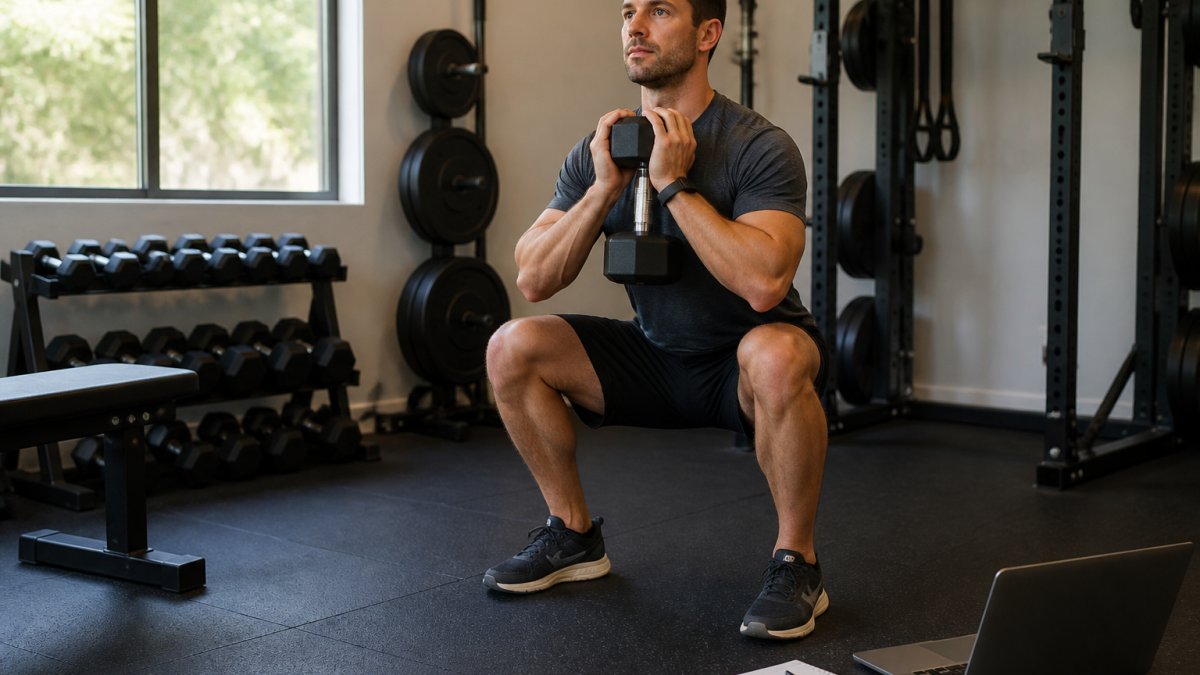
Day A: Squat, Press, Row
Start with a squat pattern, then push, then pull.
- Goblet squat or barbell squat: 3 sets of 5-8 reps
- Overhead press: 3 sets of 5-8 reps
- Bent-over row: 3 sets of 6-10 reps
- Plank: 3 sets, hold 30-45 seconds
Rest 90 seconds between heavy sets. That is the whole session.
Day B: Deadlift, Bench, Pull
Day B centers on the two biggest lifts most people know.
- Deadlift: 3 sets of 3-5 reps
- Bench press: 3 sets of 5-8 reps
- Pull-up or lat pulldown: 3 sets of 6-10 reps
- Farmer carry: 3 sets, walk 20-30 meters
Day C: Goblet Squat, Push-Up, Carry
Day C is the lightest, which keeps you fresh for the next week.
- Goblet squat: 3 sets of 8-10 reps
- Push-up or dumbbell bench: 3 sets of 8-12 reps
- Single-arm row: 3 sets of 8-10 reps per side
- Suitcase carry: 3 sets, walk 20-30 meters per side
| Day | Main Lifts | Sets x Reps | Time |
|---|---|---|---|
| A | Squat, Press, Row | 3 x 5-8 | 45 min |
| B | Deadlift, Bench, Pull | 3 x 3-8 | 45 min |
| C | Goblet Squat, Push-Up, Carry | 3 x 8-12 | 40 min |
Strength Training Frequency for Busy Adults: How Many Days Is Enough?
Three days a week is enough for most busy adults to build real strength; two works if you cannot manage three, but progress is slower. Muscle grows between sessions, not during them, so hitting each muscle group two to three times a week gives enough stimulus without burying you in fatigue.
The Minimum Effective Dose
Research consistently shows two sessions per week per muscle group is enough to gain strength, and three is slightly better. One full-body session per week maintains most of what you have built. A useful way to think about it:
- Three sessions a week: the target. Real progress, manageable recovery.
- Two sessions a week: still progress, just slower. Fine for a heavy work stretch.
- One session a week: maintenance mode. Use it during travel weeks or a crunch period.
- Zero sessions for two weeks: where motivation drops sharply and restarting feels like starting over.
Adjusting Frequency Around Travel and Crunch Weeks
When a heavy week is coming, do not plan three sessions and feel like a failure when you miss two. Plan one: a single full-body session on Sunday or a 25-minute hotel-room circuit on Tuesday night is a win. The next week, go back to three. Professionals who train consistently for years treat frequency as a dial, not a switch: busy week, turn it down; normal week, turn it back up.
Why Desk Work Changes the Frequency Math
Hours at a desk affect how recovered you feel going into a session. Sit for nine hours and then deadlift heavy, and your hips and lower back are already fatigued, so session quality drops. Two things help:
- Move every 45 to 60 minutes during the workday. A two-minute walk, a few hip hinges, or a set of bodyweight squats resets the tissue and makes the evening session feel better.
- Put your hardest session on your lightest workday. If Wednesdays are meeting-free, that is your deadlift day. Do not put your heaviest session on your worst day and then wonder why it felt terrible.
The Habit Side of Frequency
Behavioral research on habit formation suggests consistency of cue matters more than consistency of intensity: training at the same time on the same days makes it more likely you will do it, because the decision is removed. Pick a time, early morning before the inbox opens, or right after work, and defend it.
Minimalist Strength Training for Professionals: Equipment and Travel Options
Minimalist strength training for professionals means getting a full workout from almost nothing, a single pair of dumbbells and a floor is enough. The real test is the road, a hotel with no gym, or a week at a client site. That is where most programs die.
Home Setup: What Actually Earns Its Space
You do not need a rack, a platform, or a wall of plates. Here is what covers the most ground per dollar and per square foot:
- Adjustable dumbbells. A single pair that ranges from roughly 5 to 50 pounds per hand replaces an entire fixed-dumbbell rack. It is the highest-value purchase for a home lifter because it lets you keep adding weight as you get stronger, the entire point of progressive overload.
- A flat bench or a sturdy, backless chair. Needed for bench pressing, step-ups, and split squats. A backless chair works fine for most pressing and rowing variations.
- A pull-up bar that fits a doorframe. Pull-ups and chin-ups are the cheapest way to train the back hard at home. If you cannot do one yet, use it for dead hangs and negatives.
- A resistance band. Useful for warm-ups, face pulls, and adding accommodating resistance to push-ups when bodyweight alone gets too easy.
- A jump rope or a clear patch of floor. For the five-minute warm-up, not for the main work.
The Hotel-Room Plan That Maintains Strength
When you travel, the goal changes: not personal records, but holding onto what you have built so the first week back is not a rebuild. A loaded suitcase or backpack full of books replaces a dumbbell for squats and rows. Here is a 25-minute hotel-room session that hits every major pattern:
- Goblet squat with a suitcase held at the chest: 3 x 10
- Push-ups (feet elevated on the bed for more difficulty): 3 x 8-15
- Single-arm row with a suitcase: 3 x 10 per side
- Bulgarian split squat with rear foot on the bed: 3 x 8 per leg
- Glute bridge or single-leg glute bridge: 3 x 12
- Plank: 3 x 30-45 seconds
Pack a resistance band in your carry-on. It weighs almost nothing, fits in a shoe, and turns a hotel room into a usable gym for rows, presses, and face pulls. It is the single most travel-friendly piece of equipment you can own.
Bodyweight Progressions When You Have No Load
Bodyweight training only builds strength if you keep making it harder. The fix is changing leverage, not adding reps forever. A common progression:
- Push-ups: incline (hands on a desk) → standard → feet elevated → one-arm assisted
- Squats: bodyweight → pause squats → split squats → Bulgarian split squats → single-leg squats to a chair
- Rows: towel row on a door → single-arm suitcase row → one-arm inverted row under a sturdy desk
A Note on Gym Memberships for Frequent Travelers
If you travel most weeks, a national gym chain membership with multi-city access often costs less per month than a single hotel-gym drop-in fee. Check whether your health insurance or employer offers a fitness reimbursement or discounted gym network before paying full price.
Progressive Overload When You Only Have 30 Minutes
Progressive overload means adding a small amount of work over time. More weight, more reps, or better form on the same weight. Without it, your body has no reason to change.
With only 30 minutes, use this simple rule:
- Add one rep per set each week until you hit the top of your rep range
- Then add the smallest weight jump available and drop back to the bottom of the range
- Repeat
Common Mistakes That Derail Busy Professionals
The biggest mistake is chasing the perfect program instead of running a good one. A simple plan you follow beats a complex plan you abandon.
Other common traps:
- Skipping warm-ups to save time, then getting hurt and losing weeks
- Adding weight before form is solid
- Training to failure on every set, which wrecks recovery
- Ignoring sleep and food, then blaming the program
- Restarting from scratch after every missed week
Conclusion: Build the Habit, Not Just the Muscle
The hard part is not the workout. It is protecting three hours a week when work and family pull at you from every direction.
Frequently Asked Questions
What is the 3-3-3 rule for strength training?
The 3-3-3 rule is a simple framework for busy professionals: three workouts per week, three compound exercises per session, and three sets per exercise. This structure keeps each workout under 40 minutes while still hitting every major muscle group. For example, a session might include squats, bench press, and rows for three sets each. The rule works because it prioritizes compound movements and consistent frequency over volume. Research on strength training frequency supports training each muscle group two to three times weekly for steady strength gains.
Can you build significant muscle with only two 30-minute workouts per week?
Yes, you can build meaningful strength and muscle with two 30-minute full-body sessions per week, especially as a beginner or intermediate lifter. The key is intensity and compound exercises. Focus on squats, deadlifts, bench press, and rows with progressive overload. Two sessions weekly is the minimum effective dose for most people. However, three sessions produce faster results for strength gains and hypertrophy. If you can only train twice, make every set count and keep rest intervals short, around 90 seconds for compound lifts.
How do I stay consistent with strength training when work gets overwhelming?
Consistency comes from lowering the barrier to entry, not from motivation. Schedule workouts like meetings in your calendar, keep sessions to 30 minutes, and have a minimalist plan ready so you never decide what to do at the gym. On your worst weeks, do a 15-minute version with just two compound exercises. The psychological habit formation matters more than any single session. Professionals who train three days a week at the same time each day report the highest adherence. Track your workouts so you can see progress even when life is chaotic.
What equipment is essential for minimalist strength training at home?
For a minimalist home setup, you need a pair of adjustable dumbbells, a bench or sturdy step, and a pull-up bar. That covers squats, presses, rows, deadlifts, and pull-ups. If you travel frequently, resistance bands and a single kettlebell fit in a carry-on. Bodyweight exercises like push-ups, split squats, and planks require no equipment at all. The goal is to remove excuses, not to build a full gym. Start with adjustable dumbbells ranging from 5 to 50 pounds and add a kettlebell once your strength gains plateau.