 how-to
How Can You Improve Tactical Physical Readiness at Home?
Last Updated: October 25, 2026
Quick Summary
You can improve tactical physical readiness at home by building four things at once: an aerobic base, baseline strength, muscular endurance, and recovery habits. Use a weekly framework of three hard days, two easy days, and two rest days, and scale the dose to your starting level. Skip one quality and the others stall.
- Run five rounds of 40 seconds on and 20 seconds off for the bodyweight circuit, resting 60 seconds between rounds.
- Beginners start rucking with a 10-15 pound pack for 20-minute walks three times per week.
- Add only 5 pounds to your ruck after two pain-free weeks, and change one variable at a time.
- Test benchmarks like max push-ups, plank hold, and one-mile run time every six weeks, not every week.
- Cut training volume by a third for a week if resting heart rate climbs and motivation drops.
Table of Contents
- What Tactical Physical Readiness Actually Requires
- Tactical Fitness Workouts at Home: The Weekly Framework
- The Bodyweight Conditioning Workout That Builds Work Capacity
- Ruck Training for Beginners: Weighted Carries Without the Injuries
- Building a Tactical Athlete Training Program Around Your Life
- Readiness Benchmarks: How to Measure Progress at Home
- Recovery, Sleep, and Managing Training Load
- Book a Free Consultation and Build Your First Four Weeks
- Frequently Asked Questions
What Tactical Physical Readiness Actually Requires
Tactical physical readiness is the ability to meet the real demands of a job: carrying loads, moving fast under fatigue, and staying durable shift after shift. At Doug Briggs Strength, we define it around work capacity, not gym numbers.
A 2023 review in PubMed Central on training programs for tactical populations found those programs lean on high-repetition push-ups, sit-ups, pull-ups, and hard metabolic conditioning. That is the job in miniature.
So how do you improve tactical physical readiness at home? Build four things at once: an aerobic base, baseline strength, muscular endurance, and recovery habits. Skip one and the others stall.
The military is moving the same direction. The Air Force's fitness program modernization aims at durable habits that last a whole career, not a single test cycle.
Tactical Fitness Workouts at Home: The Weekly Framework
Three hard days, two easy days, two rest days. That frame fits most people, and it fits a living room. What separates a plan that works from a plan that gets abandoned is how you scale it to your starting point and how you substitute when space or equipment runs short.
| Day | Focus | Time | Effort |
|---|---|---|---|
| Monday | Strength and muscular endurance | 35 min | Hard |
| Tuesday | Aerobic base | 30 min | Easy |
| Wednesday | Bodyweight conditioning | 20 min | Hard |
| Thursday | Mobility and active recovery | 20 min | Easy |
| Friday | Ruck or weighted carry | 30 min | Moderate |
| Weekend | Rest or a walk | 30 min | Easy |
Start Where You Actually Are
Use the same weekly skeleton but change the dose. A common pattern among tactical athletes returning from a layoff is to run the intermediate plan on day one and quit by week three.
- Beginner (0-8 weeks of consistent training): two rounds of the Wednesday circuit instead of five, 15-20 minute easy sessions on Tuesday, and a 10-pound pack for 20 minutes on Friday. Monday strength work is two sets per movement, stopping two reps short of failure.
- Intermediate (3-12 months consistent): the full table as written. Monday is three to four sets, Wednesday is five rounds, Friday is 25-30 minutes at 20-30 pounds.
- Advanced (12+ months, no current injuries): add a fourth hard day only if sleep and soreness stay stable for two consecutive weeks. Increase Wednesday to six rounds or shorten rest to 15 seconds before adding load.
Advancement rule: move up a level only after two consecutive weeks where every session is completed and the readiness benchmarks in the later section hold steady or improve.
Home Equipment Substitutions and Space Constraints
You do not need a gym. You need a floor, a doorway, and something heavy.
- No pull-up bar: substitute doorway rows with a towel anchored in a closed door, or bent-over backpack rows. A pull-up bar remains the best single purchase for tactical readiness; a doorway model costs roughly $25-$40.
- No ruck: a school backpack loaded with water bottles or books works for the first 8-12 weeks. Weigh it on a bathroom scale so you know the actual load.
- No rower or bike: brisk incline walking, stair intervals in an apartment hallway, or shadow boxing rounds cover the aerobic base. Keep the talk test as your intensity gauge.
- Small space: replace burpees with squat-thrusts to a step, and jumping jacks with fast march-in-place or low step-ups. Keep the 40/20 work-to-rest ratio; the metabolic demand survives the substitution.
- Thin floors or downstairs neighbors: put a yoga mat or folded blanket under the circuit station and swap jumps for step-ups and marches.
Building Your Aerobic Base and Cardiovascular Endurance
The aerobic base is the engine under every other quality. Build it with easy running, rowing, cycling, or brisk incline walking at a pace where you can still talk.
Keep it boring. Two easy sessions a week beat one brutal one. For structured options, our guide to endurance training drills for first responders gives you drills you can run at home or on a track.
Strength and Muscular Endurance With Limited Equipment
You need almost nothing. A floor, a doorway pull-up bar, and a loaded backpack cover most of it.
Prioritize core strength, lower-body strength, and postural endurance. Those three carry rucks, stair climbs, and long shifts. Our breakdown of functional durability exercises for tactical athletes shows the movements that keep you in the field.
The Bodyweight Conditioning Workout That Builds Work Capacity
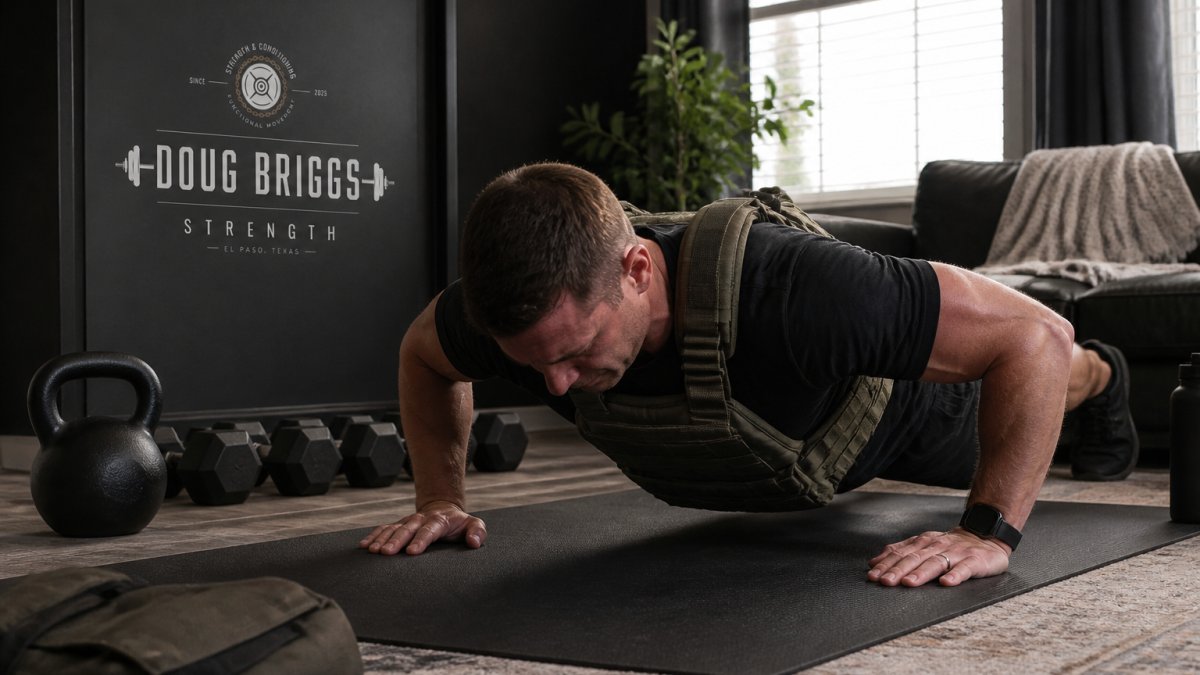
Work capacity is how much hard output you can sustain. This circuit builds it in 20 minutes with zero equipment.
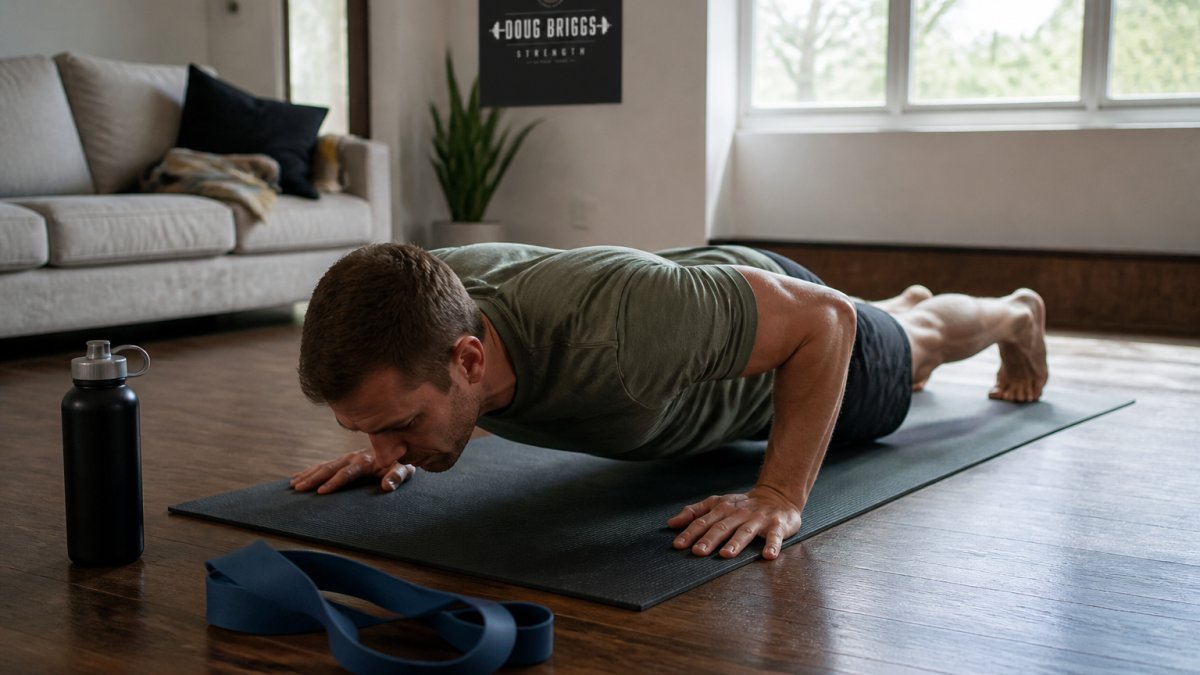
Run it as five rounds, 40 seconds on and 20 seconds off:
- Push-ups
- Air squats
- Burpees
- Jumping jacks
- Plank hold
Rest 60 seconds between rounds. Stop when form breaks, not when the clock says so.
Ruck Training for Beginners: Weighted Carries Without the Injuries
Start lighter than your ego wants. Most beginners load too much and break down within a month. The fix is a written progression with clear stop signs, not willpower.
The First Eight Weeks
- Weeks 1-2: 10-15 pound pack, 20-minute walks on flat ground, three times per week at a conversational pace. The goal is foot and hip adaptation, not heart rate.
- Weeks 3-4: same load, extend to 30 minutes. Add one session with 5 minutes of gentle incline if you have a hill or stadium steps nearby.
- Weeks 5-6: add 5 pounds only if the prior two weeks were pain-free and you completed every session. Keep duration at 30 minutes for one week after the load increase.
- Weeks 7-8: extend duration to 40-45 minutes at the new load before considering another 5-pound increase.
A common pattern is to add weight and distance in the same week. Don't. Change one variable, hold it for two weeks, then change the next.
Load, Surface, and Footwear Rules
- Keep the load high on your back and tight to your body; a pack that sways side to side taxes your hips and lower back.
- Walk on predictable surfaces, sidewalk, track, or treadmill incline, for the first month. Trail rucking adds ankle demand you have not earned yet.
- Wear supportive shoes with a firm heel counter. Running shoes with soft, worn midsoles are a poor choice under load.
- Weigh your pack on a bathroom scale. Guessing is how 15 pounds becomes 30.
When to Stop or Back Off
Progressing Beyond the Beginner Block
Once you can complete 45 minutes at 30 pounds with no symptoms for two consecutive weeks, you have a base. From there, alternate a longer easy ruck (60 minutes, same load) with a shorter, hillier one (30 minutes, same load) before touching the weight again. The Friday slot in the weekly framework is where this lives; do not stack it the day before the Wednesday circuit.
Building a Tactical Athlete Training Program Around Your Life
The best tactical athlete training program is the one you actually finish. Three days a week works if the sessions are planned and the off days are honest.
Progress one variable at a time. Add reps, then weight, then time, never all three at once. Our guide on how to apply progressive overload safely explains the order, and a training plan built for consistency shows how to hold the schedule when work runs long.
Readiness Benchmarks: How to Measure Progress at Home
Test every six weeks, not every week. Pick simple benchmarks and write the numbers down.
- Max push-ups in two minutes
- Max plank hold
- One-mile run time
- 30-minute ruck distance at fixed weight
- Five-round circuit completion time
The Army's shift toward age- and gender-normed scoring and plank-based testing is a useful reminder: compare yourself to your own last test first.
Recovery, Sleep, and Managing Training Load
Recovery is training. Sleep, food, and easy days are where the adaptations land.
Take at least one full rest day each week and keep one session truly easy. If resting heart rate climbs and motivation drops for several days, cut volume by a third for a week. That is a load management decision, not a failure.
Book a Free Consultation and Build Your First Four Weeks
Most home programs fail at week three, when the plan meets a busy calendar. That is where coaching earns its place.
At Doug Briggs Strength, we build structured programs around your life, not an app's template. You get 30+ years of coaching experience, science-backed programming, and measurable benchmarks in movement and performance. Remote clients get the same personalized attention as gym-based ones.
Personalized fitness coaching starts with a free consultation. Get started with Doug Briggs Strength and build a first month you can actually repeat.
Frequently Asked Questions
What equipment do I need for tactical fitness workouts at home?
You can build tactical physical readiness with very little: a pull-up bar, a pair of dumbbells or kettlebells, and a weighted backpack or ruck. Bodyweight exercises like push-ups, pull-ups, burpees, and jumping jacks cover most muscular endurance work, while running, rowing, or cycling handles the aerobic base. If space is tight, a doorway pull-up bar and adjustable dumbbells replace a full rack. Add a foam roller and a mat for mobility and recovery work. Start with what you own, then add load only when your movement quality holds.
How often should a tactical athlete train each week?
Three to four structured sessions per week is enough to make steady progress, especially for busy professionals. A workable split is two strength sessions, one high-intensity interval training or bodyweight conditioning workout, and one longer aerobic effort such as a ruck march or run. Keep one full rest day and use active recovery, like walking or stretching, on the others. The Air Force has described its fitness program modernization as aiming at durable habits that support sustained, career-long readiness, which favors consistency over occasional max-effort sessions.
Can you train for tactical physical readiness without a gym?
Yes. The core of tactical fitness is cardiovascular endurance, baseline strength, core strength, and work capacity, and all of those can be built at home. Bodyweight exercises, high-intensity interval training, running or rowing, and progressive ruck training cover the main demands. The limit is load: heavy lower-body strength is harder without a barbell, so use single-leg variations, tempo work, and dumbbells to keep progressing. Tracking benchmarks like push-up reps, a timed ruck, and a 2-mile run tells you whether the home plan is working.
How should I balance strength training and conditioning?
Alternate hard days rather than stacking them. Put strength work on separate days from high-intensity interval training, and keep long aerobic efforts away from heavy lower-body sessions. A simple rule: two strength days, one or two conditioning days, and one longer endurance day, with at least one full rest day. If your ruck or run times stall, cut conditioning volume before cutting strength. If your strength numbers stall, check sleep and recovery first. Progressive overload works only when recovery keeps pace with training intensity.