 listicle
5 Basic Strength Training Exercises for Beginners
Table of Contents
- Why the Five Basic Strength Training Movements Matter
- The 5 Basic Strength Training Exercises Explained
- Basic Strength Training Exercises: Form Cues and Substitutions
- Strength Training for Beginners: Equipment and Modifications
- Your First Full-Body Strength Workout
- How Often to Strength Train for Real Results
- Safety, Pain, and When to Get Professional Guidance
- Conclusion
- Frequently Asked Questions
Last Updated: October 17, 2026
Why the Five Basic Strength Training Movements Matter
Strength training is the practice of challenging your muscles against resistance so they adapt and grow stronger. At Doug Briggs Strength, we teach beginners that almost every useful exercise is a variation of five fundamental movement patterns.
That is the answer most guides bury under a wall of options. The American College of Sports Medicine physical activity guidelines recommend resistance training for adults of all ages, and pattern-based training is how we make those guidelines practical.
Here is the core argument of this guide: beginners fail not from lack of effort but from unbalanced programs. People default to what feels familiar, usually pushing movements, and skip the pulling and hinging work their bodies need.
The 5 Basic Strength Training Exercises Explained
The five basic strength training exercises are the squat, hip hinge, push-up, row, and plank. Together they cover every major muscle group and both sides of the body, which is why a program built on these five produces balanced, usable strength rather than a strong chest and a fragile back.
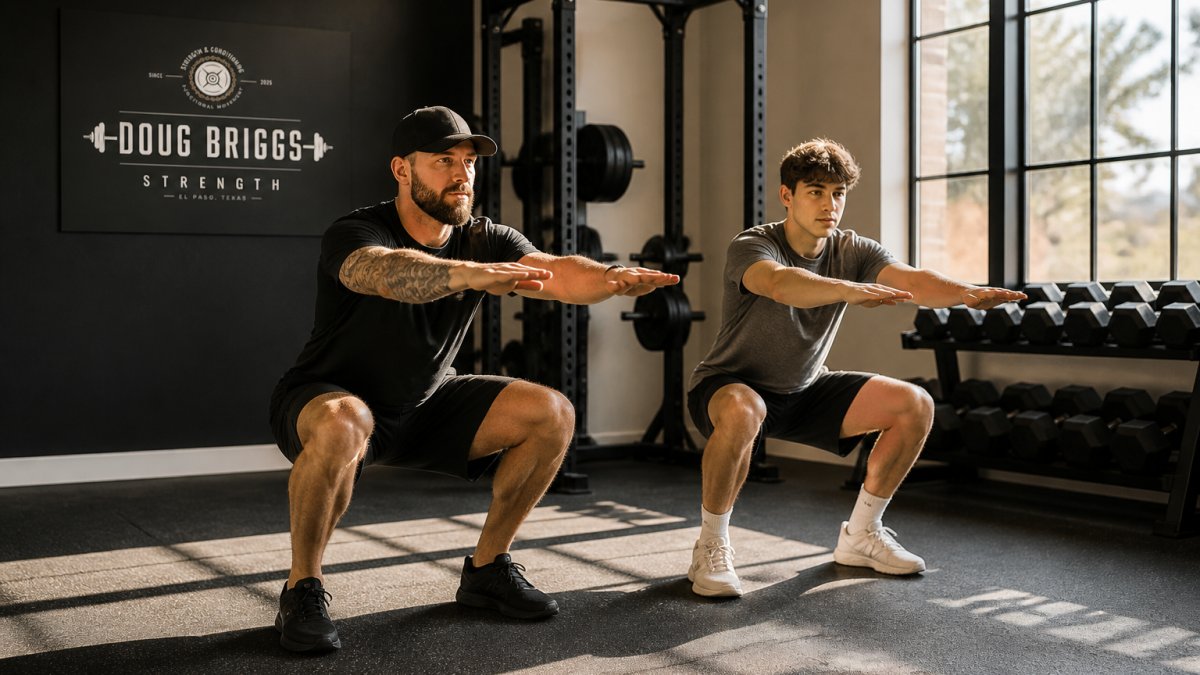
1. Squat: The Lower-Body Foundation
The squat trains the squat pattern: sitting your hips down and standing back up. It builds the quadriceps, glutes, and trunk.
How to do it:
- Stand with feet about shoulder-width apart, toes slightly out.
- Push your hips back and bend your knees at the same time, keeping your chest tall.
- Lower until your thighs are near parallel, or as far as you can go with a neutral spine.
- Drive through your whole foot to stand.
The most common mistake is letting the knees collapse inward. Push them gently out over your toes as you descend.
2. Hip Hinge: Building the Posterior Chain
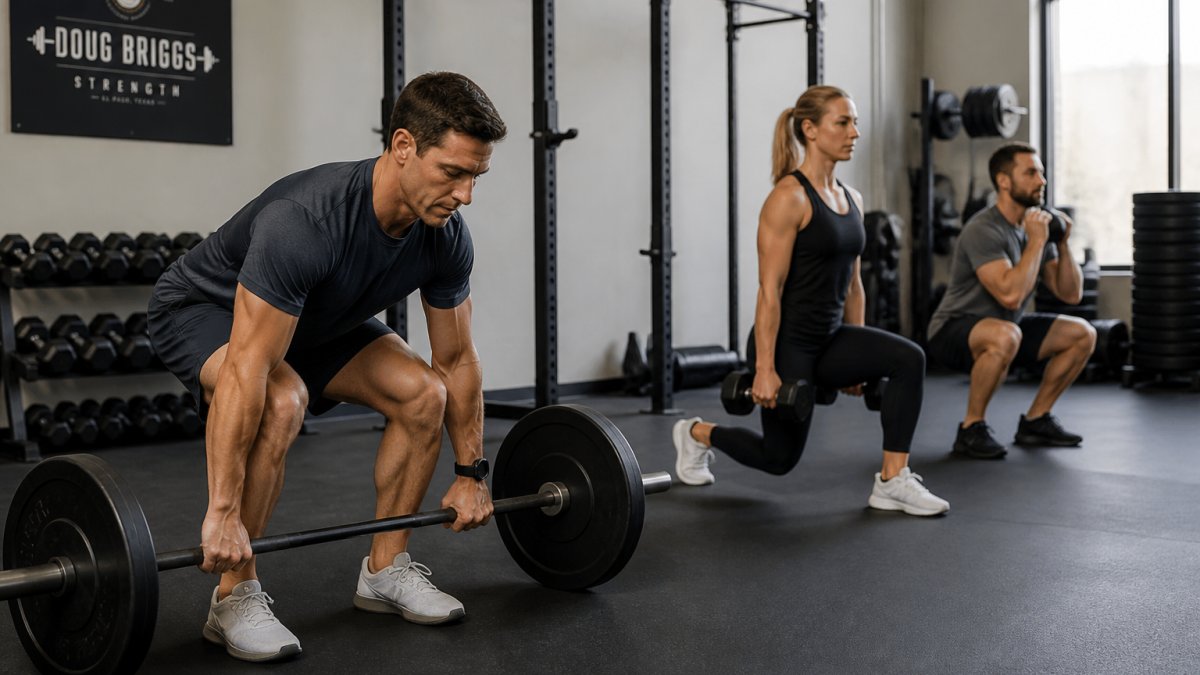
The hip hinge trains bending at the hips with a flat back, loading the hamstrings, glutes, and lower back. It is the pattern behind deadlifts and most athletic speed.
How to do it:
- Stand tall with a soft knee bend.
- Push your hips straight back, letting your torso tip forward.
- Keep your back flat and your shins nearly vertical.
- Squeeze your glutes to return to standing.
Think "close a car door with your hips," not "bend over." If your lower back rounds, you have gone too far.
3. Push-Up: The Horizontal Press
The push-up is a horizontal press that trains the pectorals, anterior deltoids, and triceps while demanding core stability.
How to do it:
- Set your hands slightly wider than your shoulders.
- Hold a straight line from head to heels, glutes tight.
- Lower your chest toward the floor with elbows at roughly 45 degrees.
- Press back up without letting your hips sag.
A common mistake is flaring the elbows straight out to the sides, which strains the shoulders. Keep them tucked at an angle.
4. Row: The Essential Pull
The row is the pull pattern, and it is the exercise beginners skip most often. It trains the upper back, rear deltoids, and biceps, and it balances all that pressing work.
How to do it:
- Hinge at the hips or brace against a bench with one hand.
- Hold a dumbbell or resistance band with the working arm hanging straight.
- Pull your elbow back toward your hip, squeezing your shoulder blade.
- Lower slowly under control.
If you only add one exercise to a push-heavy routine, add this one.
5. Plank: Core Strength That Transfers
The plank trains core strength by teaching your trunk to resist movement, which carries over to every lift and everyday task.
How to do it:
- Set your forearms on the floor under your shoulders.
- Extend your legs and squeeze your glutes.
- Hold a straight line from head to heels, breathing normally.
- Stop when your hips start to sag, not when the clock says so.
Quality beats duration. A tight 20-second plank beats a sloppy two-minute one.
Basic Strength Training Exercises: Form Cues and Substitutions
Not every body can perform every pattern as written, and that is normal. The table below pairs each basic strength training exercise with its key form cue and a substitution for different abilities or equipment.
| Pattern | Key Form Cue | Substitution |
|---|---|---|
| Squat | Knees track over toes | Box squat or sit-to-stand |
| Hip hinge | Hips back, back flat | Glute bridge or band pull-through |
| Push-up | Elbows at 45 degrees | Incline push-up or wall push-up |
| Row | Squeeze the shoulder blade | Band row or inverted row |
| Plank | Ribs down, glutes tight | Knee plank or dead bug |
Strength Training for Beginners: Equipment and Modifications
You do not need a full gym to start strength training for beginners. Bodyweight covers the squat, push-up, and plank.
What matters more than equipment is progressive overload: gradually increasing resistance or reps as the movements get easy. Add a rep or a small amount of weight every week or two, and your muscles will keep adapting.
Most beginners get stuck because they cannot map a piece of equipment to a movement pattern. Use this substitution map to apply the five basics at home, in a hotel room, or in a commercial gym.
| Pattern | Bodyweight option | Band option | Dumbbell option | Easier variation | Harder variation |
|---|---|---|---|---|---|
| Squat | Bodyweight squat | Banded squat | Goblet squat | Sit-to-stand from a chair | Pause squat or split squat |
| Hip hinge | Glute bridge | Band pull-through | Dumbbell Romanian deadlift | Hip bridge with feet elevated | Single-leg Romanian deadlift |
| Push-up | Incline push-up | Band-resisted push-up | Dumbbell floor press | Wall push-up | Feet-elevated push-up |
| Row | Inverted row under a sturdy table | Band row | One-arm dumbbell row | Seated band row | Chest-supported row |
| Plank | Knee plank | Banded plank | Plank with dumbbell drag | Dead bug | Plank with shoulder taps |
A few practical notes on equipment:
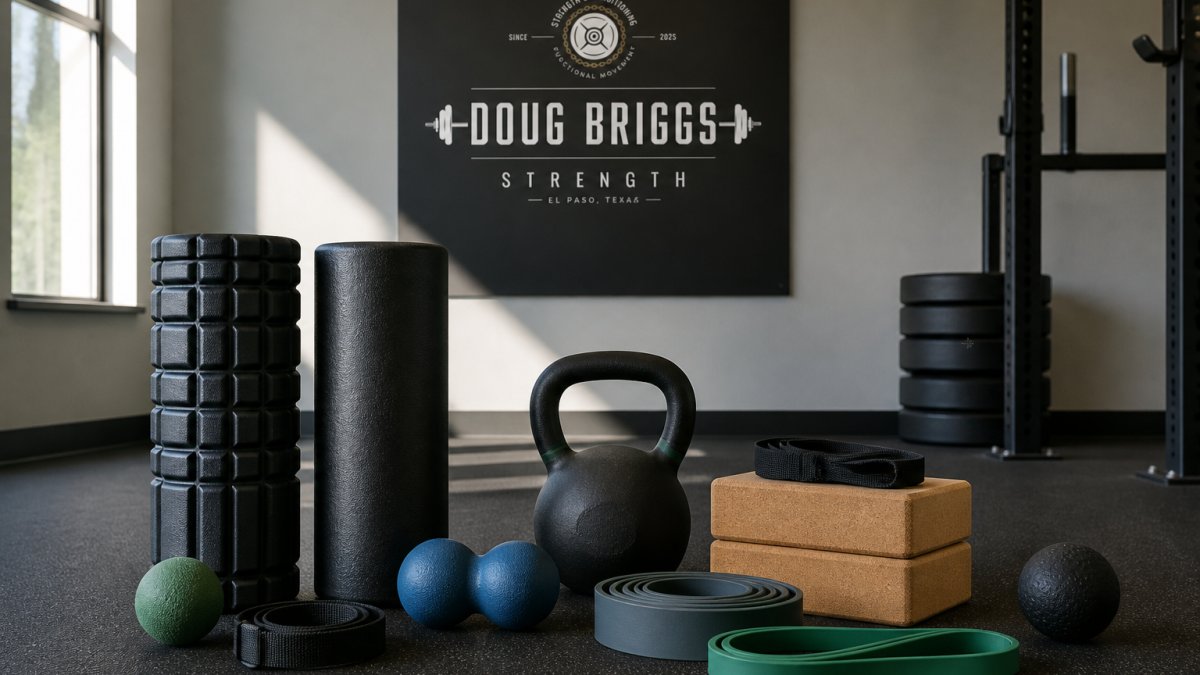
- Resistance bands are graded by tension, not by a single weight number. A light, medium, and heavy band set covers most beginner needs and travels easily.
- Dumbbells are the simplest way to load the hinge and row with measurable progress. Adjustable dumbbells save space if you train at home.
- A loaded backpack with books or water bottles is a legitimate substitute for a dumbbell in a goblet squat or row when nothing else is available.
- A sturdy chair, bench, or box is the most underrated piece of beginner equipment because it makes squats and push-ups scalable.
Progressive overload does not require adding weight every session.
Your First Full-Body Strength Workout
A balanced full-body strength workout hits all five patterns in one session. Run it two to three times per week on non-consecutive days.
- Squat: 2-3 sets of 8-12 reps
- Hip hinge: 2-3 sets of 8-12 reps
- Push-up: 2-3 sets of 6-12 reps
- Row: 2-3 sets of 8-12 reps
- Plank: 2-3 sets of 20-40 seconds
Rest 60-90 seconds between sets. Start with two sets per exercise and add a third when you recover well. This is where personalized coaching earns its keep: at Doug Briggs Strength, we adjust sets, reps, and rest to fit your schedule, whether that is three days a week or two.
How Often to Strength Train for Real Results
Most beginners should strength train two to three times per week, with at least one rest day between sessions.
Consistency beats intensity. Three focused sessions every week for months will outperform sporadic hero workouts every time.
Here is a practical weekly schedule that applies the five basics. Run it on non-consecutive days, such as Monday, Wednesday, and Friday.
| Day | Session | Sets and reps | Rest |
|---|---|---|---|
| Monday | Full body: squat, hinge, push-up, row, plank | 2-3 sets of 8-12 reps; plank 20-40 seconds | 60-90 seconds between sets |
| Tuesday | Rest or easy walking | , | , |
| Wednesday | Full body: same five patterns | 2-3 sets of 8-12 reps; plank 20-40 seconds | 60-90 seconds between sets |
| Thursday | Rest or easy walking | , | , |
| Friday | Full body: same five patterns | 2-3 sets of 8-12 reps; plank 20-40 seconds | 60-90 seconds between sets |
| Saturday | Rest or light activity | , | , |
| Sunday | Rest | , | , |
If three days is unrealistic, two full-body sessions per week still produce progress for a beginner. The key is hitting all five patterns in each session rather than splitting them across days you may miss.
How to progress week to week:
- Start with two sets per exercise for the first two weeks. Focus on clean form and consistent breathing.
- When you can complete the top of your rep range (12 reps) with two sets and recover well, add a third set.
- Once three sets of 12 reps feel controlled, add a small amount of resistance or move to a harder variation from the substitution table.
- Deload or repeat the previous week if sleep, stress, or soreness makes a session feel unusually hard. Progress is not linear.
A common pattern is to increase volume or load every one to two weeks, not every session. Beginners often make the mistake of adding weight before they have earned it with reps and clean technique.
Safety, Pain, and When to Get Professional Guidance
Muscle soreness a day or two after training is normal. Sharp pain, joint pain, or pain that worsens during a lift is not, and it is your signal to stop and reassess.
If you have an old injury, a flare-up, or a medical condition, get cleared by a physician before starting. A qualified coach can then modify the five patterns around your limitations rather than removing them.
At Doug Briggs Strength, our evidence-based approach comes from more than 30 years of coaching youth, adult, and tactical athletes, and it starts with safe technique before load. If you are unsure whether strength training is right for your situation, a conversation with a coach is the fastest way to find out.
Conclusion
The hard part of strength training is not the exercises. It is staying consistent long enough to see the change, and knowing which movements to prioritize when life gets busy. The five basics give you a simple, balanced framework you can run anywhere.
If you want a plan built around your body, your schedule, and your goals, Doug Briggs Strength offers personalized, evidence-based coaching with structured programs, hands-on gym-based seminars, and measurable results in movement and performance. Book a free consultation and we will map your first four weeks together.
Frequently Asked Questions
Which strength exercises should beginners learn first?
Start with the five basic movement patterns: squat, hip hinge, push-up, row, and plank. These cover your lower body, posterior chain, upper-body push and pull, and core. Beginners should practice bodyweight versions first, like a box squat, glute bridge, incline push-up, band row, and knee plank, before adding dumbbells or a barbell. Two to three sets of 8 to 12 reps with proper form builds a safe foundation before you increase resistance.
How often should beginners do strength training?
Two to three full-body sessions per week is the standard starting point. That gives each muscle group 48 hours of rest and recovery between workouts, which is when strength is actually built. A Monday-Wednesday-Friday schedule works well for most busy adults. As you adapt, you can add a fourth day or split upper and lower body. Consistency over months matters more than squeezing in extra sessions early on.
Can five exercises work the whole body?
Yes, when the five cover all major movement patterns. A squat trains quadriceps and glutes, a hip hinge hits the posterior chain and hamstrings, a push-up works pectorals, anterior deltoids, and triceps, a row builds the upper back and biceps, and a plank trains core strength. Together they hit every major muscle group. Add progressive overload by increasing reps, sets, or resistance over time to keep seeing results.
How do the five basics differ from the six-pattern framework?
The six-pattern model adds a carry or loaded walk, like a farmer's carry, to the squat, hinge, push, pull, and core patterns. The five-exercise approach folds that loaded carry benefit into the plank and hinge work, keeping the routine shorter for beginners. Both frameworks are valid. If your goal is grip strength and conditioning for tactical or athletic work, adding a carry is a smart sixth movement once the basics feel solid.