 How-to
How to Build Strength With a Shoulder Injury
Last Updated: November 17, 2026
Quick Summary
To build shoulder injury strength, train within a pain-free range, load gradually, and track your response over 24 hours. If pain is the same or less the next day, the exercise was safe; if it is worse, the load or range was too much.
- Keep pain during a set at 3/10 or lower and let it settle within one hour.
- Avoid increases of more than 10-15% of working weight, spaced 10-14 days apart.
- Start with 2-3 sets of 8-15 reps at a pain-free load, resting 60-90 seconds.
- Do the home band and scapular sequence 2-3 days per week.
- Stop and seek assessment for sharp pain, sudden weakness, or no improvement after 4-6 weeks.
Table of Contents
- Start With a Pain-Free Baseline Before You Add Load
- Shoulder Pain Exercises to Avoid Until Symptoms Settle
- How to Regain Strength After Shoulder Injury With Progressive Overload
- Shoulder Exercises at Home That Build Stability
- How to Run a Full Body Workout With Shoulder Injury
- When to Stop Exercising and Get a Medical Assessment
- Book a Free Consultation With Doug Briggs Strength
- Frequently Asked Questions
Start With a Pain-Free Baseline Before You Add Load
Building shoulder injury strength starts with one rule: find the movements you can do without pain, then earn the right to add weight. For the broader companion to this article, see our safe guide to strength training with a shoulder injury. People who rush load re-injure. People who respect the baseline rebuild.
The exact keyword question, how to build strength with shoulder injury, has a simple answer: train the shoulder within a pain-free range, load it gradually, and track your response over 24 hours. A 2022 review indexed by PubMed Central found that strengthening exercise, alone or combined with stretching, had a large effect on reducing shoulder pain in cohort studies without comparators (systematic review of shoulder disorder guidelines).
That is your permission slip to train. Not to max out.
The 24-Hour Rule for Judging Whether an Exercise Is Safe
The 24-hour rule is simple: if a shoulder exercise leaves you with the same or less pain the next day, it was safe. If pain is worse 24 hours later, the load or range was too much.
Use this checklist before adding weight:
- Pain during the set stays at 3/10 or lower
- Pain settles within one hour after training
- Next morning feels the same or better
- No new clicking, catching, or night pain
Two bad days in a row means back off. That is not weakness. That is data.
Shoulder Pain Exercises to Avoid Until Symptoms Settle
Certain shoulder pain exercises to avoid deserve a temporary ban while symptoms are hot. These are not forever, just until the joint calms down. The problem with most published lists is that they treat every sore shoulder the same. A 28-year-old with a two-week impingement flare and a 55-year-old with a diagnosed rotator cuff tear need different temporary bans, different substitutions, and different timelines for reintroduction.
Use the list below as a starting point, then match it to the stage of your injury.
The Usual Suspects and Why They Irritate the Shoulder
- Heavy overhead presses and behind-the-neck presses: end-range flexion and external rotation load the front of the joint capsule and the subacromial space.
- Upright rows with a close grip: internal rotation plus elevation narrows the subacromial space, the classic impingement position.
- Wide-grip bench presses and deep dips: the shoulder drifts into extension and anterior glide under load.
- Kipping pull-ups and ballistic throws: uncontrolled speed at end range, where irritated shoulders complain most.
- Flat barbell bench with a fixed bar path: the bar locks your hands in one plane, so your shoulder cannot find a comfortable path.
Why these positions? The 2022 Bern Consensus Statement on Shoulder Injury Prevention notes that clinicians should pay attention to end-range flexion and abduction deficits (Bern Consensus Statement on shoulder injury). Translation: the end ranges are exactly where irritated shoulders complain.
Match the Modification to Your Injury Stage
A decision framework beats a static list. Ask two questions: how hot is the shoulder right now, and do you have a diagnosis?
Acute flare (first 1-2 weeks, pain above 4/10, night pain): ban all five movements above. Substitute neutral-grip pressing, landmine presses, and cable work. Keep range to roughly 60-90 degrees of elevation and stop before the pinch.
Persistent symptoms (weeks to months, pain 2-4/10, no night pain): keep the overhead and behind-the-neck presses banned, but reintroduce wide-grip bench and dips at reduced range and load if the 24-hour rule holds.
Clinician-diagnosed condition (rotator cuff tear, labral repair, instability): follow the clinician's protocol first. Your temporary ban list may be longer and your reintroduction timeline may be measured in months, not weeks.
Reintroduction Rules
Bring one banned movement back at a time, at roughly 50% of your previous working load and half your previous range. Hold it for two weeks. If the 24-hour rule holds and no new clicking, catching, or night pain appears, add a small amount of load or range.
Watch out: cutting these lifts entirely for months without replacing them. You lose strength you will have to rebuild later, and the shoulder loses the tolerance it needs to return to those patterns.
How to Regain Strength After Shoulder Injury With Progressive Overload
Progressive overload is the practice of adding small, planned increases in load over time. To regain shoulder injury strength, add weight slowly, space increases out, and let pain response, not ego, set the pace.
A return-to-weightlifting guideline advises avoiding increases of more than 10-15% of your current working weight at a time, with increases spaced 10-14 days apart (returning to weightlifting guideline). That is a conservative, joint-friendly pace. Use it.
Here is how we apply it in practice:
- Week 1-2: establish pain-free working weight
- Week 3: add 5-10% if the 24-hour rule held
- Week 4-5: hold steady, build reps instead
- Week 6: add another small jump
For a deeper walkthrough of the pacing and safety checks, see our guide on how to apply progressive overload safely.
Sets, Repetitions, and Rest Periods That Work
For shoulder rehabilitation, start with 2-3 sets of 8-15 reps at a pain-free load, resting 60-90 seconds between sets. Higher reps with lighter load build tolerance before heavier work.
| Goal | Sets | Reps | Rest | Load |
|---|---|---|---|---|
| Pain tolerance | 2 | 12-15 | 60 sec | Very light |
| Rebuild strength | 3 | 8-12 | 90 sec | Moderate |
| Return to heavy | 3-4 | 5-8 | 2-3 min | Near max |
Reps
Stay at each stage for at least two weeks. Most people skip stage two. Do not.
Shoulder Exercises at Home That Build Stability
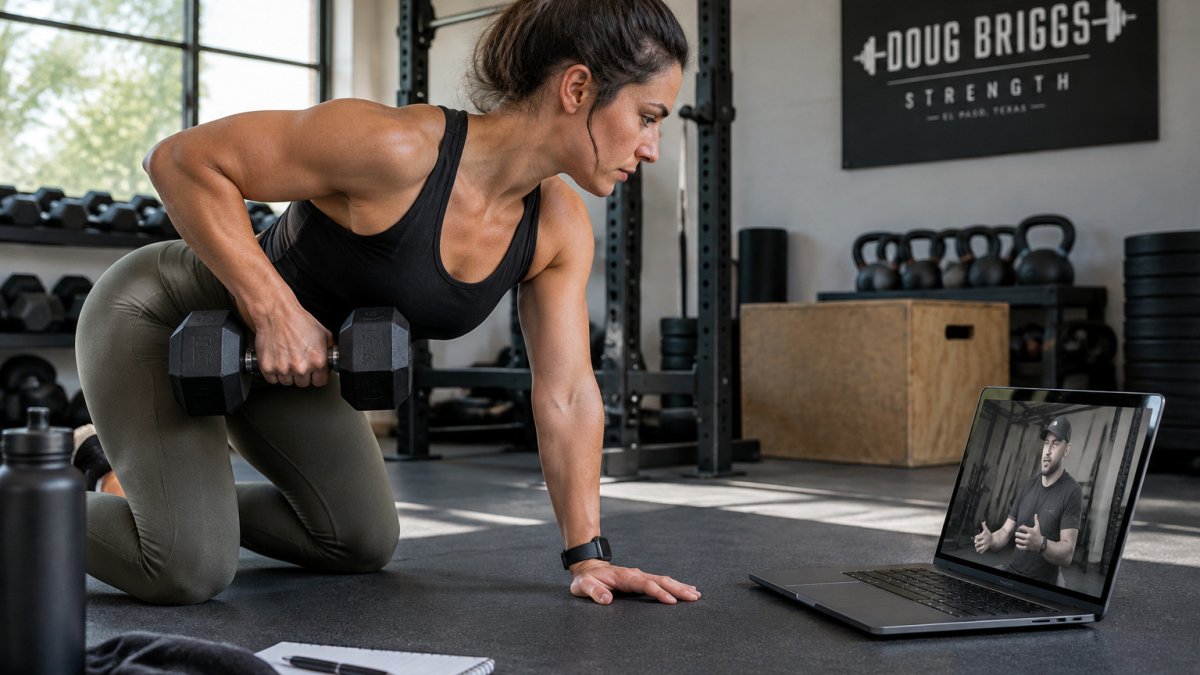
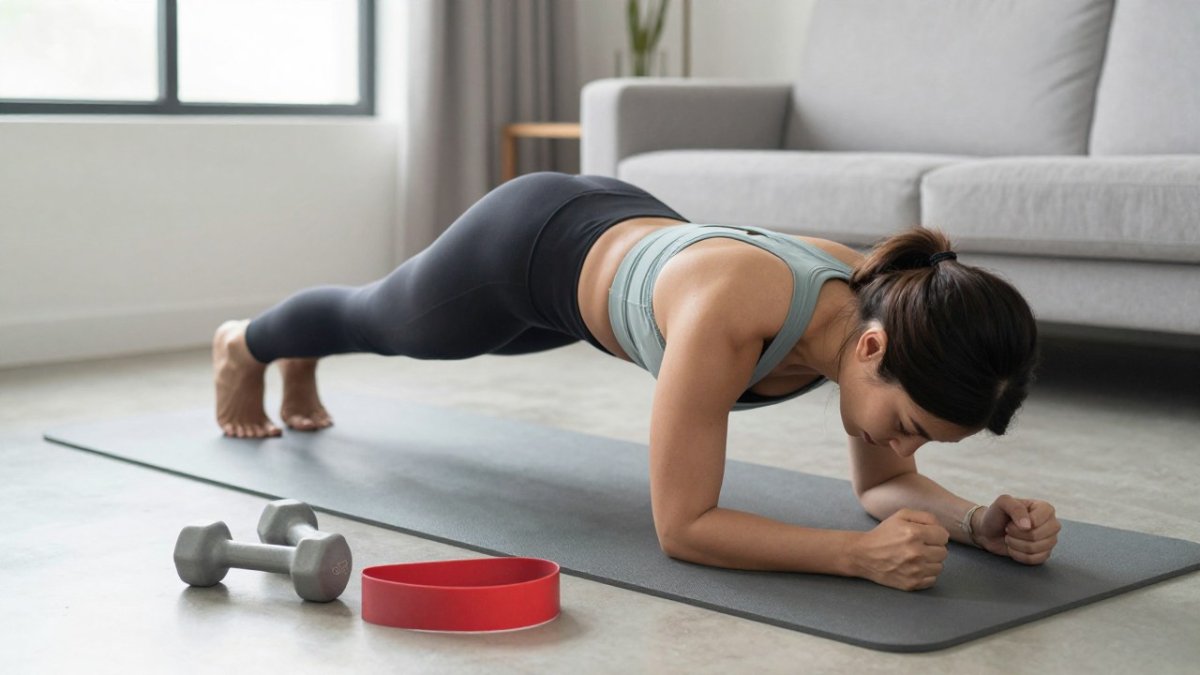
Home training can rebuild shoulder stability with minimal gear. A band, a light dumbbell, and a mat cover most of it. What most home programs miss is a progression: a way to move from easy band work to loaded training without guessing when to advance.
The woman is American.
Try this sequence 2-3 days per week, as the 2026 AAOS conditioning program recommends for shoulder-supporting muscles (AAOS rotator cuff conditioning program):
- Band external rotations: 2 x 12 each side
- Band pull-aparts: 2 x 15
- Scapular push-ups: 2 x 10
- Shoulder taps in plank: 2 x 8 each side
- Light lateral raises to 60 degrees: 2 x 12
Keep range of motion comfortable. Stop before the pinch.
Pain-Monitoring Rules During and After the Session
Use the 24-hour rule as your gate. During the set, keep pain at 3/10 or lower. After training, pain should settle within one hour. The next morning should feel the same or better, with no new clicking, catching, or night pain.
A common pattern is to feel fine during band work and sore the next morning. That soreness is data, not failure. It tells you the range or the rep count was a step too far.
A Three-Phase Progression From Bands to Loaded Training
Phase 1, Pain-tolerant movement (weeks 1-2): the sequence above, very light band tension, full comfortable range. Advance when you can complete all sets with pain at 2/10 or lower and no next-day flare.
Phase 2, Build tolerance (weeks 3-6): add one set to each exercise, increase band tension one level, and add a light dumbbell to the lateral raise. Keep the 24-hour rule as the gate.
Phase 3, Loaded stability (weeks 7+): move to dumbbell external rotations, single-arm cable or band rows, and controlled overhead pressing within a pain-free range.
Common Mistakes at Home
- Rushing the band tension because light feels too easy. Light is the point in Phase 1.
- Skipping the scapular work because it looks boring. The scapular muscles are the foundation the rotator cuff pulls against.
- Training through a pinch because "no pain, no gain." A pinch is a signal, not a challenge.
- Adding load before range is comfortable. Range first, then load.
If mobility is your limiter, pair this with mobility work for athletes so strength and range improve together.
How to Run a Full Body Workout With Shoulder Injury
A full body workout with shoulder injury works by training the lower body and core hard while the shoulder rebuilds. You do not need to pause your whole program.
Structure it like this:
- Lower body: squats, split squats, hip hinges, sled pushes
- Core: dead bugs, carries, anti-rotation presses
- Shoulder-safe upper work: rows, neutral-grip presses, band work
- Conditioning: bike, incline walk, rower with a neutral grip
The Human Kinetics guidance on modifying weight training for shoulder pain recommends decreasing total load or slowing movement speed to reduce stress on the shoulder (modifying weight training for shoulder pain). Slower tempo is an underrated tool.
New to structured training? Our beginner strength training guide shows how to build the base.
When to Stop Exercising and Get a Medical Assessment
Stop exercising and seek a medical assessment if you have sharp pain, sudden weakness, a pop with immediate loss of function, night pain that wakes you, or no improvement after 4-6 weeks of careful training.
Red flags that need a clinician, not a program:
- Inability to lift your arm at all
- Visible deformity after a fall
- Numbness or tingling down the arm
- Pain that keeps getting worse week over week
A case report in the literature describes exercise therapy improving pain and function in a total supraspinatus tear, but that was one case under supervision (exercise therapy for rotator cuff tear case report).
We are coaches, not doctors. Get the diagnosis first, then we build the plan around it.
Book a Free Consultation With Doug Briggs Strength
Doug Briggs Strength brings 30+ years of coaching experience, credentials including CSCS,*D and RSCC,*E, and programs built on science and experience.
Here is what a plan with us includes:
- A structured program tailored to your goals and lifestyle
- Load management built around your shoulder, not against it
- Consistent accountability so habits stick
- Measurable progress in movement and performance
If you are ready for personalized guidance, our guide on hiring an online strength coach walks through the process step by step.
Your shoulder does not have to sideline you. It needs a plan that respects where it is today and builds toward where you want to be. Doug Briggs Strength offers personalized programming, evidence-based progression, and the accountability that keeps you consistent.
Frequently Asked Questions
Can I do strength training with an injured shoulder?
Yes, in most cases, provided you train within a pain-free range and progress gradually. Start with light loads, keep reps controlled, and apply the 24-hour rule: if pain worsens the next day, reduce load or range before your next session.
Which shoulder pain exercises should I avoid when injured?
Temporarily modify movements that load the shoulder at end range or under speed: behind-the-neck presses, upright rows, deep dips, heavy overhead pressing, and wide-grip bench pressing. Swap these for neutral-grip presses, landmine presses, and supported rows. If any movement causes sharp pain during the set or lingering soreness the next day, cut the range or drop the load rather than pushing through.
How long does it take to regain strength after a shoulder injury?
Timelines vary by injury type and stage, so no single number applies to everyone. What you can control is the pace of progression: noticeable strength gains typically show up over weeks to months of consistent training, not days. A coach or clinician can help you set milestones that match your specific diagnosis.
How do I modify a full body workout for shoulder pain?
Keep the lower body and trunk training heavy, and reduce shoulder loading to what you can do pain-free. Swap barbell back squats for safety-bar or front-rack variations if the bar position irritates the shoulder, replace push-ups with incline or floor variants, and use cable or band rows instead of heavy free-weight rows. Shoulder-supporting muscles can be strengthened with exercises performed 2-3 days per week, so you do not need daily shoulder work to make progress.