 ultimate-guide
Personalized Fitness Coaching: See Measurable Results
Table of Contents
- Why Personalized Fitness Coaching Beats Generic Programs
- Movement Assessment: The Starting Point for Real Progress
- Fitness Progress Tracking That Goes Beyond the Scale
- Strength Training Progress: What to Measure and When to Retest
- Personal Trainer vs. Group Training: Which Gets Better Results?
- How to Distinguish Real Progress from Normal Measurement Variation
- Personalization for Injuries, Chronic Conditions, and Life Circumstances
- Frequently Asked Questions
Last Updated: October 7, 2026
Why Personalized Fitness Coaching Beats Generic Programs
Personalized fitness coaching is one-on-one training built around your assessment results, goals, schedule, and injury history rather than a template anyone can download.
Here is the problem with off-the-shelf plans. They assume a healthy shoulder, a flexible hip, and five available training days.
The fix is not more motivation. It is a program that starts with what your body actually does today, then progresses from there.
Movement Assessment: The Starting Point for Real Progress
A movement assessment is a structured screen of how you squat, hinge, push, pull, and carry weight, used to find restrictions before they become injuries.
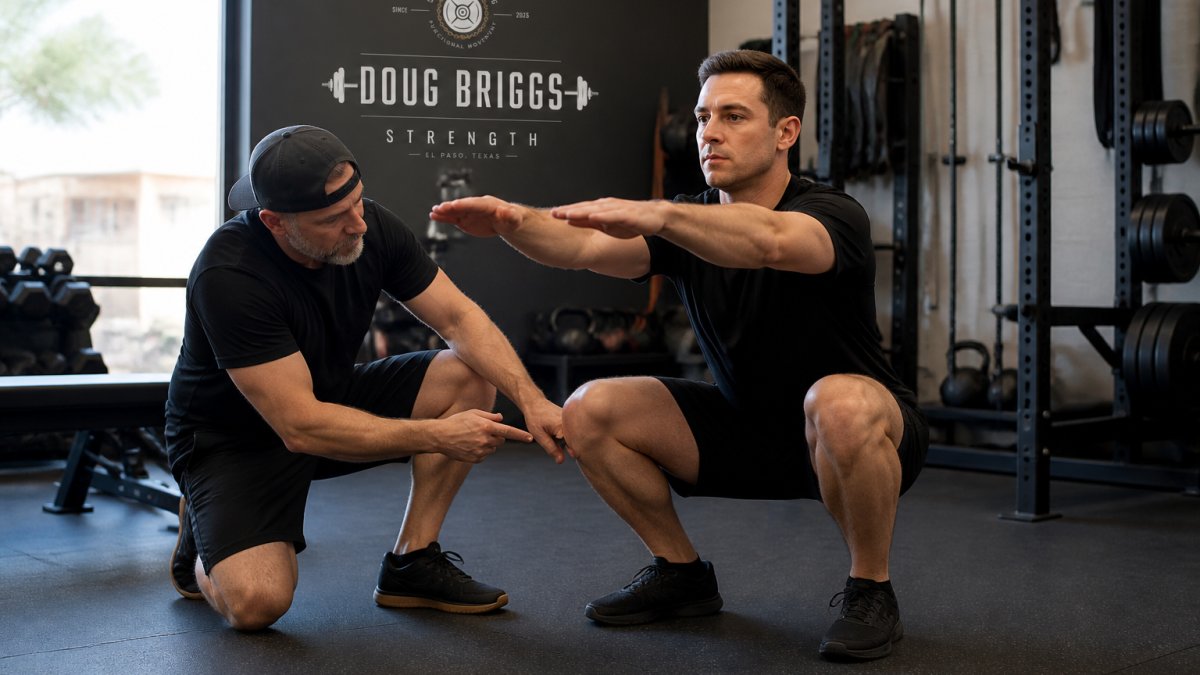
A proper assessment covers four things:
- Range of motion at ankles, hips, and shoulders, measured against a standard
- Movement quality under load, not just bodyweight
- Asymmetry between left and right sides
What most guides miss is that the assessment is not a one-time test. It is the reference point for every retest that follows.
For readers managing an old injury, this step is where safety gets decided. A shoulder that flares up under overhead pressing does not mean strength training is unsafe.
Fitness Progress Tracking That Goes Beyond the Scale
Fitness progress tracking is the practice of recording performance and movement measures on a fixed schedule so you can compare results over time.
Build a scorecard with four columns: what you measured, the baseline value, the retest interval, and the current value. Track these categories:
| Category | Example Measure | Retest Interval |
|---|---|---|
| Strength | Trap bar deadlift 5-rep max | Every 6-8 weeks |
| Muscular endurance | Push-ups to technical failure | Every 4 weeks |
| Cardiovascular fitness | Resting heart rate, timed 1-mile | Every 4-6 weeks |
| Movement quality | Overhead squat depth, single-leg balance | Every 8 weeks |
| Body composition | Waist circumference, lean mass trend | Every 8-12 weeks |
Movement quality deserves its own line because it changes before strength numbers do.
CDC physical activity guidelines for Americans recommend adults get at least 150 minutes of moderate aerobic activity and two days of muscle-strengthening work each week.
Strength Training Progress: What to Measure and When to Retest
Strength training progress is best measured by load lifted for a fixed rep range, tracked over a consistent retest interval.
Three measures matter most:
- Load progression on your primary lifts, retested every 6-8 weeks
- Training volume, calculated as sets times reps times load, tracked weekly
- Technique quality at a given load, assessed by a coach or on video
The retest interval matters as much as the measure. Testing too often produces noise and fatigue. Testing too rarely means you miss a stalled program for months.
When a lift stalls, the answer is rarely "try harder." It is usually one of three things: insufficient recovery, too much volume at the same intensity, or a movement restriction upstream of the lift.
Personal Trainer vs. Group Training: Which Gets Better Results?
Personal trainer vs. group training comes down to feedback density, how many corrective cues you receive per rep, and how fast the plan can change when your data says it should. Group sessions win on accountability and cost per session. One-on-one coaching wins on correction, individual programming, and the ability to adjust the plan the moment a retest says to.
The deciding factor is not which model is better in the abstract. It is how far your situation deviates from the average person in the room. Use this decision framework:
- Choose group training when you are injury-free, self-directed, and mainly need structure, a scheduled time, and social accountability. Your programming needs are close to the group's, so individual attention buys you little.
- Choose one-on-one training when you have an injury history, a specific performance goal, or a schedule that changes week to week. You need exercise selection and progression that a group template cannot provide.
- Choose hybrid or remote coaching when you train alone most days but need periodic technique review and program adjustment. You get individual programming without paying for a coach to watch every set.
What Each Model Can Actually Measure
The delivery model changes what data you can collect, and that changes what you can prove.
| Model | Strength of measurement | Weak spot |
|---|---|---|
| Group training | Attendance, class-level volume, group benchmarks | Individual technique quality and asymmetry are rarely tracked |
| One-on-one in person | Technique quality, range of motion, asymmetry, load progression, all observed live | Cost and scheduling; fewer sessions per week |
| Remote or hybrid | Logged load and volume, video technique review, retest scores you record yourself | Depends on your logging discipline; no hands-on cueing |
A common pattern is that remote clients who film one working set per lift each week get technique feedback nearly as precise as in-person clients, because the coach can pause, rewind, and compare frames across weeks. What remote coaching loses is the immediate hands-on cue mid-rep.
The Honest Limitations
The limitation of group training is arithmetic: one coach cannot watch eight people at once, and form breaks down under fatigue when nobody catches it. The limitation of one-on-one coaching is cost and scheduling, you may train fewer days per week than a group member simply because sessions cost more.
For tactical professionals and athletes training around shift work, the deviation from the average is usually large enough that individual programming pays for itself.
How to Distinguish Real Progress from Normal Measurement Variation
Real progress is a change that holds across multiple sessions and shows up in more than one measure.
Body weight can move several pounds in a day from hydration and food volume alone. A single bad training session says almost nothing.
Use these rules:
- Trend, not point. Compare rolling averages over 2-3 weeks, not single readings
- Two measures minimum. Strength up plus waist down is progress. Strength up alone might be a good day
- Same conditions. Retest at the same time of day, same equipment, same warm-up
- Repeat before reacting. One missed rep is not a plateau. Three weeks of missed reps is
This is the part most people get wrong. They change programs after one bad session, which resets the adaptation cycle before it can produce anything.
Personalization for Injuries, Chronic Conditions, and Life Circumstances
Personalization means adjusting exercise selection, volume, and progression to fit your body and your week, including injuries, chronic conditions, age, and the reality of your schedule. A plan you can complete beats a better plan you cannot. Most general fitness advice assumes a healthy, unencumbered trainee with five open training days.
Here is a decision framework for the four situations that most often require adaptation.
1. Injury History
Swap painful ranges for tolerable ones, then progressively reload the original range as tolerance improves. A shoulder that flares under overhead pressing does not mean strength training is unsafe, it means the program needs a different pressing angle and a slower progression. The rule: train the pattern, not the painful position. If a movement causes sharp pain, regress the range or the load; if it causes only mild discomfort that fades, keep it and monitor.
2. Chronic Conditions
Coordinate with your physician on intensity limits, then program within them. exercise guidance for chronic conditions outlines how movement is generally adapted rather than avoided for most conditions. The practical sequence is: get clearance on what to avoid, then build the program around what remains. Cardiovascular work, resistance training, and mobility work can almost always be scaled rather than dropped.
3. Age and Training Experience
Older trainees and true beginners usually need more recovery between sessions, not less training. A 55-year-old returning to lifting after a decade off may progress faster on two full-body sessions per week than on a four-day split, because the limiting factor is recovery, not stimulus. Experience level changes the starting load and the rate of progression, not the need for assessment.
4. Schedule and Life Circumstances
If you can train three days a week, the program is built for three days, not a five-day plan you will abandon by week three. Shift workers, new parents, and people in travel-heavy jobs need a program with a minimum effective dose and a clear plan for missed sessions. The measurement system has to survive the disruption too: a missed week is not a failed program, it is a data point.
How Delivery Model Fits In
Remote and hybrid coaching can deliver all four adaptations. The assessment happens on video, the program is adjusted from your logged data, and technique review happens through recorded sets.
We build every Doug Briggs Strength program around this principle. A busy professional training three days a week gets a different structure than a tactical athlete training five, and both get the same assessment-first process.
Frequently Asked Questions
How do you measure progress in a personalized fitness program?
A well-structured personalized fitness coaching program uses a baseline assessment, then tracks specific metrics at regular intervals. Common measures include movement quality (squat depth, overhead reach), strength (how much you lift for a given rep range), cardiovascular fitness (resting heart rate, timed distance), and body composition (lean mass, waist circumference). Rather than relying on a single number, coaches compare several data points over time. This approach shows whether your training volume, exercise selection, and recovery are producing adaptation or whether adjustments are needed.
What movement tests can show whether your training is working?
Movement assessment tools like the overhead squat, single-leg balance, and push-up test reveal changes in mobility, stability, and control. A coach might measure how deep you can squat without your heels lifting, how far you can reach overhead without arching your lower back, or how many clean push-ups you can complete. Improvements in these movement patterns often show up before changes in weight or body composition, making them a useful early indicator that your program is working.
How often should a coach reassess a fitness program?
Most coaches reassess every 4 to 8 weeks, depending on your training age and goals. Beginners may see movement quality improvements in 2 to 3 weeks, while strength gains typically show on a retest at the 6-week mark. Regular reassessment allows your coach to adjust training volume, exercise selection, and progression based on how you are adapting. Waiting too long between assessments means you might spend weeks on a program that is no longer challenging or appropriate.
How long does it take to see measurable results from strength training?
Neurological adaptations, like better coordination and muscle recruitment, can improve strength within 2 to 4 weeks. Noticeable muscle gain typically takes 6 to 12 weeks of consistent training. Movement quality often improves first, which is why a movement assessment at the start and again at 6 weeks can show progress even before the mirror does. With personalized fitness coaching, your program is adjusted along the way so you do not plateau early.
What should you track besides body weight when measuring fitness progress?
Body weight alone misses changes in lean mass, visceral fat, and performance. Better indicators include waist-to-hip ratio, how many push-ups or pull-ups you can do, how much weight you lift for a set number of reps, resting heart rate, and how quickly you recover between efforts. A coach might also track range of motion, like how far you can reach or how deep you can squat. These measures give a fuller picture of strength training progress and health outcomes.
Is personalized coaching more effective than using a fitness app?
Apps can provide structure and variety, but they cannot see your movement, adjust for an old shoulder injury, or know when you need a lighter day. Personalized fitness coaching includes movement assessment, exercise technique feedback, and program progression based on how you respond. A coach also holds you accountable in a way an app cannot. For people with specific performance goals or physical limitations, supervised training often leads to better outcomes and fewer setbacks.