 comparison
Tactical Strength vs Bodybuilding: Key Differences
Table of Contents
- Tactical Strength Training vs Bodybuilding: Core Differences
- Functional Strength Training: Movement Over Muscle Size
- Bodybuilding: Muscle Hypertrophy and Aesthetics
- Tactical Strength and Endurance Workouts: Conditioning as Core
- Building a Tactical Conditioning Program: Practical Structure
- Can You Combine Bodybuilding Methods with Tactical Preparation?
- Which Approach Is Right for Your Goals?
- Frequently Asked Questions
Last Updated: October 12, 2026
Tactical Strength Training vs Bodybuilding: Core Differences
Choosing between tactical strength training and traditional bodybuilding means choosing between two different goals. Tactical strength training prioritizes functional movement, occupational readiness, and real-world performance. Bodybuilding focuses on muscle hypertrophy and aesthetics. At Doug Briggs Strength, we work with athletes across both spectrums, and training for one goal often undermines the other.
The core difference is alignment, not which approach is "better." If your job demands explosive power, sustained work capacity, and durability under fatigue, tactical strength training is your framework. If your goal is muscle size and definition, bodybuilding delivers more efficiently.
Training Goals and Outcomes
Tactical strength training prepares you for the physical demands of real work: strength that transfers to job-specific tasks like carrying an injured person, moving quickly in gear, or performing across an entire shift.
Bodybuilding measures success differently: maximizing muscle hypertrophy, the size and definition of individual muscle groups. You optimize for aesthetic development, with visual and subjective metrics, though muscle mass and body composition percentage provide objective markers.
This distinction shapes everything downstream: tactical athletes prioritize movement patterns that replicate job demands, while bodybuilders prioritize isolation exercises targeting specific muscles from multiple angles. One builds durability; the other builds size.
Performance Metrics That Matter
In tactical strength training, you track metrics that predict job performance: absolute strength, work capacity, movement quality under fatigue, and conditioning markers like time to completion on loaded carries or circuit work.
Bodybuilders track muscle circumference, body fat percentage, and how muscle groups appear from different angles. Strength matters only insofar as it supports progressive overload.
Fatigue affects performance differently too. A tactical athlete must maintain movement quality and decision-making under exhaustion; a bodybuilder's concern is whether fatigue interferes with reaching the target rep range and volume for muscle development.
Functional Strength Training: Movement Over Muscle Size
Functional strength training builds strength through movement patterns that replicate real-world demands, emphasizing compound movements that involve multiple joints and muscle groups working together, in contrast to bodybuilding's isolation focus.
Compound Movements and Real-World Transfer
Compound movements form the foundation of tactical strength training. Squats, deadlifts, pressing variations, and loaded carries engage multiple muscle groups and train patterns you'll actually use.
This is where movement transfer happens. A heavy front squat builds leg strength that transfers to climbing stairs in gear; a farmer's carry builds grip and core stability for carrying equipment or a person.
Bodybuilding relies on isolation exercises targeting specific muscles from specific angles: a leg curl isolates the hamstring, a pec deck isolates the chest. These aren't inherently bad, but they train muscle groups rather than movement patterns, so strength gains transfer less effectively to real-world tasks.
Work Capacity and Occupational Readiness
Work capacity, the ability to sustain high-quality work output over time, is central to tactical training: performing demanding movements repeatedly without significant degradation in technique or power output.
Building work capacity requires volume, intensity, and conditioning integrated into strength work: moving moderately heavy weight repeatedly while maintaining movement quality. That's why tactical strength programs combine strength work with conditioning circuits.
Bodybuilding programs build work capacity in a narrower sense: many sets and reps on isolation exercises. This builds muscular endurance in specific movements but doesn't translate to the broad work capacity tactical roles need.
Bodybuilding: Muscle Hypertrophy and Aesthetics
Traditional bodybuilding is optimized for one outcome: maximizing muscle size and definition, through progressive overload, training volume, and exercise selection that targets muscles from multiple angles.
Isolation Exercises and Progressive Overload
Bodybuilding relies on isolation exercises targeting individual muscles or muscle groups. Leg curls, pec decks, lateral raises, and machine movements let you load a specific muscle from a specific angle, accumulating high volumes on one muscle group without the injury risk of complex movement patterns.
Tactical strength training uses progressive overload too, applied to compound movements and work capacity metrics: increasing weight on squats or deadlifts, adding reps to circuits, or reducing time to completion on conditioning work. The progression serves movement quality and performance, not just muscle size.
Training Volume, Splits, and Recovery
Bodybuilding programs typically use training splits, dedicating specific days to specific muscle groups: chest and triceps Monday, back and biceps Tuesday, legs Thursday, shoulders Friday. This allows high volume per muscle group with recovery between sessions.
The volume is substantial: 15-20 sets per muscle group per week across multiple exercises and rep ranges.
Tactical strength training uses lower frequency for specific movements but emphasizes total-body work capacity.
Recovery demands differ too. Bodybuilders need adequate recovery between sessions targeting the same muscles; tactical athletes need recovery supporting both strength and conditioning adaptations, often through shorter, more frequent sessions.
Tactical Strength and Endurance Workouts: Conditioning as Core
Conditioning isn't an afterthought in tactical strength training; it's central. Tactical roles demand sustained performance under load and fatigue, requiring integrated conditioning alongside strength development.
Cardiovascular Fitness and Muscular Endurance
Tactical strength and endurance workouts build cardiovascular fitness alongside muscular endurance. This isn't just running; it's maintaining movement quality and power output while fatigued.
Muscular endurance here means performing loaded movements repeatedly without significant fatigue: carrying 50 pounds for 5 minutes without form breakdown, or 20 bodyweight pull-ups without stopping. These metrics predict occupational performance.
Bodybuilding programs include conditioning work, but it's secondary: 10-15 minutes of moderate cardio after strength work for recovery and cardiovascular health. Conditioning isn't integrated into the strength work itself; the focus remains the strength and hypertrophy session.
Loaded Carries and Dynamic Movement Patterns
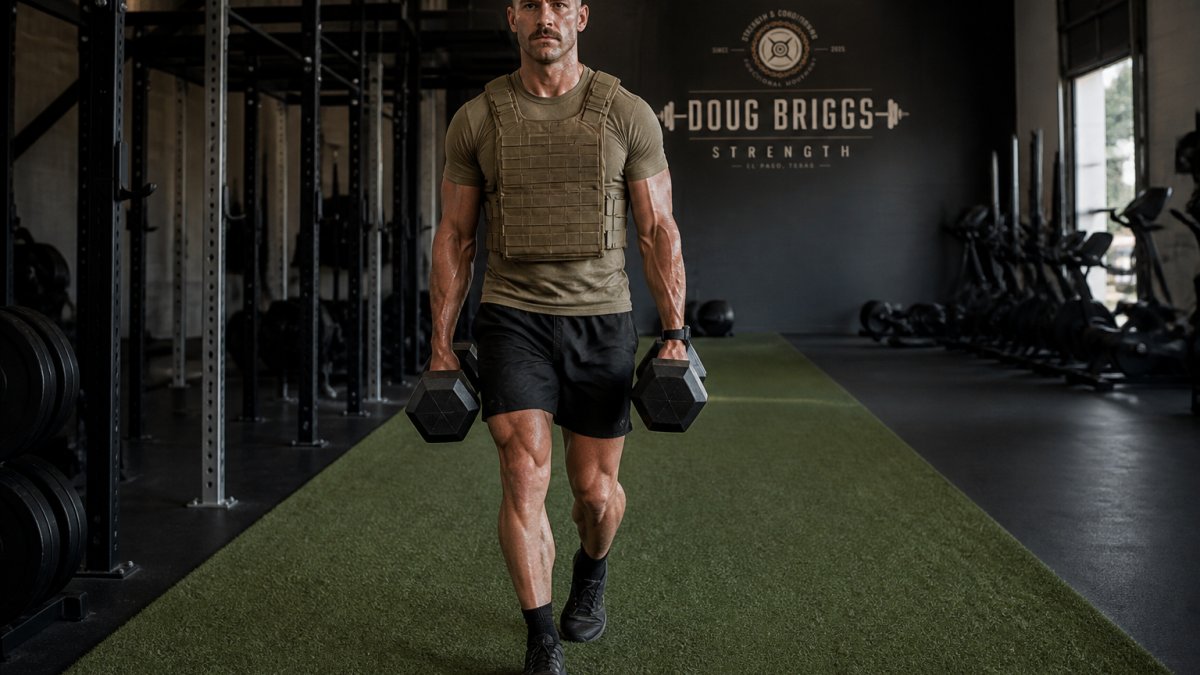
Loaded carries, farmer's carries, sled pushes, and sandbag carries are staples of tactical strength training because they build work capacity, grip strength, core stability, and movement quality simultaneously. A 5-minute loaded carry trains your ability to move under load, maintain posture, and sustain effort.
Dynamic movement patterns, explosive movements, changes of direction, and complex footwork are also central, training the nervous system to produce power and coordinate movement under real-world conditions. Bodybuilding programs include limited explosive work because it carries higher injury risk and contributes less directly to hypertrophy.
| Aspect | Tactical Strength Training | Traditional Bodybuilding |
|---|---|---|
| Primary Goal | Occupational readiness and performance | Muscle hypertrophy and aesthetics |
| Exercise Focus | Compound movements and loaded carries | Isolation exercises and muscle targeting |
| Training Volume | Moderate, distributed across patterns | High, concentrated per muscle group |
| Conditioning Role | Integrated and central | Secondary and supplementary |
| Performance Metrics | Work capacity, movement quality, occupational tasks | Muscle size, definition, body composition |
| Training Frequency | Higher frequency, shorter sessions | Lower frequency per muscle group, longer sessions |
| Recovery Emphasis | Supports strength and conditioning adaptations | Supports hypertrophy and muscle repair |
Building a Tactical Conditioning Program: Practical Structure
A tactical conditioning program combines strength work with conditioning circuits that build work capacity and movement quality under fatigue, structured very differently from bodybuilding splits.
Exercise Selection for Tactical Athletes
Exercise selection in tactical training prioritizes movement patterns over muscle groups, asking: What movements does this role demand, what patterns need training, and what work capacity is required?
A tactical athlete's program might include compound lifts (squat, deadlift, pressing variations) for a strength foundation, loaded carries for work capacity and core stability, explosive movements (box jumps, medicine ball throws) for power, and conditioning circuits combining movement patterns with cardiovascular demand.
Bodybuilding exercise selection asks instead: Which muscles need development, which angles haven't been targeted, and how can I accumulate volume on this specific muscle group? The answers lead to different exercise choices.
Programming Examples by Role and Demands
A law enforcement officer might prioritize explosive power, sustained cardiovascular capacity, and moving quickly in gear: box jumps and medicine ball work for explosiveness, loaded carries and sled work for work capacity, and conditioning circuits replicating duty demands.
A bodybuilder doesn't differentiate programs by occupational demands; the program is structured around muscle groups and splits regardless of actual movement demands. That's efficient for hypertrophy but misses occupational readiness entirely.
Can You Combine Bodybuilding Methods with Tactical Preparation?
Yes, but with clear trade-offs. You can use isolation exercises and higher volume to build muscle while incorporating tactical strength and conditioning work, but you can't optimize for both simultaneously. Something has to give.
Supersets, Training Intensity, and Injury Prevention
Combining approaches often means supersets, pairing exercises to increase training density: a compound lift followed immediately by an isolation exercise, then conditioning work. This builds strength, addresses muscle development, and maintains work capacity.
Training intensity matters here. High-volume isolation work plus conditioning circuits significantly increases recovery demands, requiring adequate sleep, nutrition, and rest between sessions. Push too hard on both fronts and you'll plateau or increase injury risk.
Injury prevention becomes more important when combining approaches. Isolation exercises carry lower injury risk as simpler patterns, but adding conditioning circuits and complex movements increases demand on connective tissue and the nervous system.
Trade-Offs in Recovery and Movement Quality
The biggest trade-off is recovery. Bodybuilding requires substantial recovery between sessions targeting the same muscles. Adding tactical conditioning work increases overall training stress. You might find yourself under-recovered, not fully adapted to either stimulus.
Movement quality suffers too when balancing competing goals. Fatigue from conditioning can degrade strength training form, and hard isolation work can leave no energy for quality conditioning. At some point you're managing fatigue rather than driving adaptation.
That's why most successful athletes specialize. A competitive bodybuilder doesn't emphasize tactical conditioning; a tactical athlete doesn't prioritize hypertrophy. They focus on what matters for their goal and accept that optimizing for one thing means de-emphasizing another.
Which Approach Is Right for Your Goals?
Choose tactical strength training if your primary goal is occupational readiness, real-world performance, or movement quality under load.
Choose bodybuilding methods if your primary goal is muscle development and aesthetic improvement. This framework efficiently builds muscle size and definition, making it right when appearance and muscle development are your primary objectives.
Many people benefit from a hybrid approach, using tactical strength training as the foundation while incorporating some isolation work for balanced development.
The key is clarity about your goal. Once you know whether you're optimizing for occupational readiness or muscle development, the training approach follows logically. Trying to optimize for both wastes time and energy.
If you're training for tactical readiness or managing occupational demands, you need a program built around movement quality and work capacity, not generic app-based training. According to the National Strength & Conditioning Association guidance on tactical athlete preparation, personalized programming tailored to specific occupational demands produces measurable improvements in performance and injury resilience.
Frequently Asked Questions
What is the main difference between tactical strength training and bodybuilding?
Tactical strength training prioritizes functional fitness, occupational readiness, and real-world movement transfer over muscle aesthetics. Bodybuilding focuses on muscle hypertrophy and appearance through isolation exercises and high training volume. Tactical athletes develop strength, power, and conditioning for task-specific demands like carrying loads, climbing, or sustained physical exertion. Bodybuilders emphasize muscle size and definition using progressive overload and controlled repetition ranges designed for growth.
Can you combine bodybuilding methods with a tactical conditioning program?
Yes, but with careful balance. Isolation exercises and supersets from bodybuilding can build muscle and work capacity, but they must support, not replace, compound movements and conditioning work essential to tactical fitness. The trade-off is recovery demand and training time. A tactical athlete might use bodybuilding-style volume for specific muscle groups while keeping compound lifts, loaded carries, and conditioning as the foundation. Periodizing intensity and managing fatigue becomes critical to prevent injury and maintain movement quality.
Which training approach builds more functional strength?
Functional strength training builds more direct movement transfer and occupational readiness. It emphasizes compound movements, bodyweight progressions, and dynamic patterns that carry over to real-world tasks. Bodybuilding builds absolute strength and muscle mass but less directly transfers to functional demands because isolation exercises don't train movement patterns or stability in the same way. For tactical athletes, military personnel, or anyone needing strength for specific tasks, functional strength and tactical conditioning provide measurable performance gains in those specific domains.
What measurable outcomes should I expect from tactical strength training?
Expect improvements in work capacity, movement efficiency, and occupational performance. Measurable outcomes include faster loaded carries, better core stability, improved cardiovascular fitness, and sustained strength under fatigue. You should see gains in compound lift performance, reduced injury risk, and better recovery between intense efforts. Results depend on your baseline and training consistency. Personalized programming accelerates results by addressing your specific demands and limitations.