 ultimate-guide
The Complete Guide to Athletic Performance Training
Last Updated: November 7, 2026
Quick Summary
Athletic performance training is the structured development of strength, speed, power, agility, and endurance to meet the specific demands of a sport or physically demanding job. It starts with a movement screen and baseline testing, then uses periodized blocks that alternate harder and lighter weeks. Programs should fit your real schedule, because three consistent sessions beat six abandoned ones.
- A meta-analysis of 23 studies covering 460 elite athletes found resistance training significantly enhanced sport-specific performance.
- The strength-and-conditioning segment of the youth sports performance training market was valued at USD 4.32 billion in 2026.
- Beginners should start with three full-body strength sessions per week and master six to eight core lifts.
- Retest the same markers every six to eight weeks so the comparison stays honest.
- A common pattern is three weeks of building load followed by one lighter week.
Table of Contents
- What Athletic Performance Training Actually Means
- How Athletic Performance Training Differs From General Fitness
- Building an Athletic Performance Training Program That Fits Your Life
- Athletic Performance Training Exercises That Drive Results
- Athletic Performance Training for Beginners: Where to Start
- Tactical Athlete Conditioning for First Responders and Operators
- Measuring Progress and Testing What Matters
- Book a Free Consultation With Doug Briggs Strength
- Frequently Asked Questions
What Athletic Performance Training Actually Means
Athletic performance training is the structured development of strength, speed, power, agility, and endurance to meet the specific demands of a sport or physically demanding job.
A meta-analysis of 23 studies covering 460 elite athletes found that resistance training significantly enhanced sport-specific performance (Makaruk et al., PubMed Central(https://pmc.ncbi.nlm.nih.gov/articles/PMC11057612/)).
The market reflects that demand.
Below, we explain exactly how to assess, program, and progress athletic performance training so it fits real life.
How Athletic Performance Training Differs From General Fitness
General fitness aims to make you healthier.
A general fitness plan might chase 10,000 steps and a lighter scale weight.
The core difference comes down to intent and measurement. General fitness tracks how you look and feel.
If you want the full breakdown of how tactical strength work diverges from bodybuilding aesthetics, read Tactical Strength vs Bodybuilding: Key Differences.
Building an Athletic Performance Training Program That Fits Your Life
A performance program only works if you can actually complete it. Three training days per week, executed consistently for months, beats a six-day plan abandoned in three weeks. Consistency is the output of good design, not a personality trait. The process below turns an athlete's sport demands, schedule, and training history into a plan that survives a real season.
Step 1: Screen Before You Program
Every program starts with a screen, not a template. A movement screen checks the positions your sport loads: ankle and hip mobility for a sprinter, shoulder and thoracic rotation for a thrower or swimmer, trunk control and single-leg stability for anyone who cuts and decelerates.
Watch out: skipping the screen because the athlete "feels fine" is how a manageable asymmetry becomes a mid-season flare-up.
Step 2: Define the Sport Demand and the Gap
Write down what the sport actually rewards. A basketball player needs repeated deceleration, change of direction, and jumping on tired legs. A soccer player needs repeated sprint ability and aerobic recovery between efforts. A tactical athlete needs loaded carries, trunk stability under fatigue, and work capacity across a long shift. Compare that list to the screen and baseline test results.
Step 3: Set a Baseline You Can Retest
Before week one, record a small set of markers: a strength benchmark on two or three core lifts, a short sprint or acceleration time, a jump test, and a movement screen score. Keep the list short enough that you will actually repeat it. We retest the same markers every six to eight weeks so the comparison is honest.
Step 4: Periodize the Year, Not Just the Week
Periodization is the planned sequencing of training stress and recovery across weeks and months. A practical structure most athletes can follow has three layers:
- Preparation block (off-season or early base): higher volume, moderate intensity, broad strength and movement quality work, gradual build in conditioning.
- Competition block (in-season): lower volume, higher intensity on a few key lifts, speed and power maintained with short, frequent doses, and enough recovery to play or work at full effort.
- Transition or restoration block: reduced structured load, active recovery, and addressing the nagging issues that got ignored during the season.
Within each block, alternate harder and lighter weeks rather than chasing a personal record every session. A common pattern is three weeks of building load followed by one lighter week, adjusted to how the athlete is recovering. Add load, volume, or complexity only when the athlete has earned it with clean technique and stable recovery.
Step 5: Manage Workload and Recovery Together
Recovery is not a rest day you squeeze in; it is the phase where adaptation actually happens. Track sleep hours, soreness, energy, and how the athlete feels during warm-ups.
Watch out: treating sleep disruption as an inconvenience rather than a training variable is the most common way tactical and shift-working athletes derail an otherwise sound plan.
Step 6: Build Around the Real Schedule
A plan that ignores the calendar is fiction. Map the week around fixed commitments: practices, games, shifts, school, and travel. Place the highest-quality strength and speed sessions where the athlete is freshest, and use shorter maintenance sessions on crowded days. For a deeper walkthrough of adding load without breaking technique, see how to apply progressive overload safely.
Athletic Performance Training Exercises That Drive Results
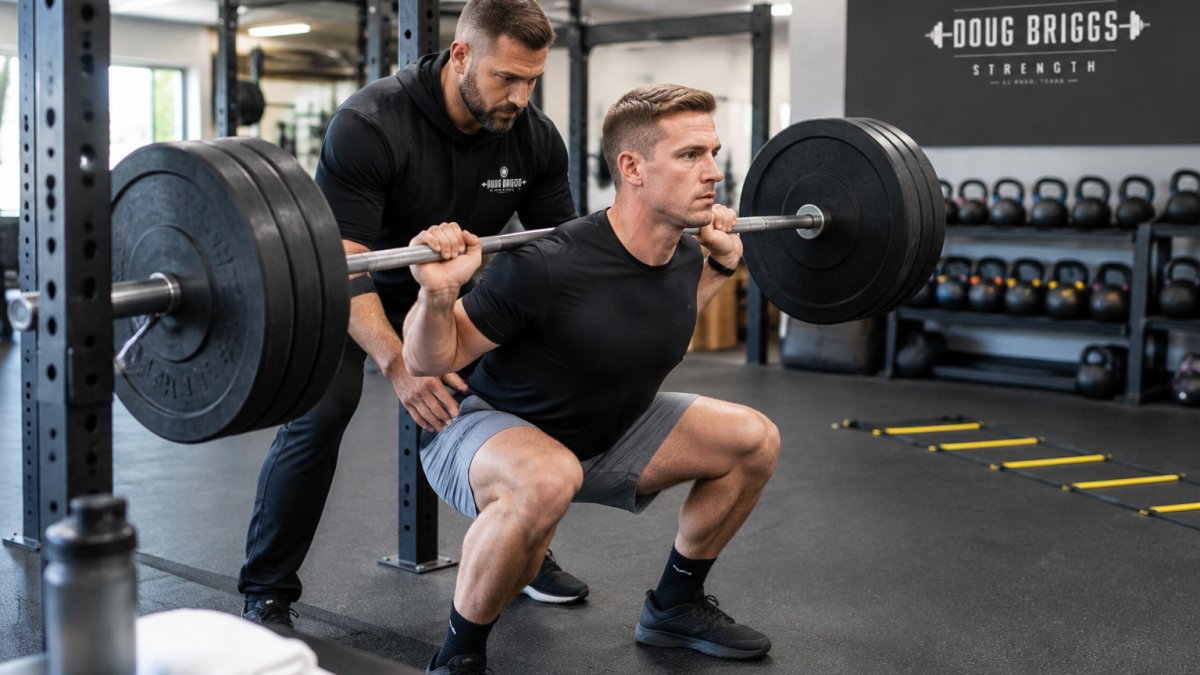
The best athletic performance training exercises are the ones that build force, speed, and control in patterns your sport actually uses. We organize them into four buckets and rotate emphasis across the training week.
Strength, Speed, Power, and Agility Work
- Strength: squats, trap-bar deadlifts, split squats, and pressing variations build the base everything else sits on.
- Speed: short accelerations, sled pushes, and sprint mechanics work develop acceleration and top-end speed.
- Power: jumps, throws, and Olympic-lift variations train explosive legs and rate of force development.
Build strength first, then layer speed and power on top. Agility work belongs in fresh sessions, not tacked onto the end of a fatigued one.
Athletic Performance Training for Beginners: Where to Start
Beginners should start with three full-body strength sessions per week, master movement quality on six to eight core lifts, and add speed work only after a base is established. Simple, repeated, and progressive beats complicated every time.
The first month is about learning positions: how to hinge, squat, brace, and land. Load increases come second. A beginner who spends four weeks drilling technique will out-progress one who chases weight in half the time.
If you want a concrete starting point, our 5 basic strength exercises for beginners lays out the exact lifts and set-and-rep scheme we use with new athletes.
Tactical Athlete Conditioning for First Responders and Operators
Tactical athlete conditioning trains for the unpredictable: carrying uneven loads, moving under fatigue, and staying composed when heart rate spikes. The job does not offer a deload week, so the training has to build durability alongside performance.
Programs for first responders and operators emphasize work capacity, grip and carry strength, trunk stability, and energy system development.
For the full deep-dive, read The Complete Guide to Tactical Athlete Training.
Measuring Progress and Testing What Matters
You cannot manage what you do not measure. But measurement only helps if the tests are repeatable, the protocols are consistent, and you know what a meaningful change looks like.
Choose a Small, Repeatable Test Battery
Pick four to six markers that map to the sport and can be repeated the same way every time. A practical battery for most field and court athletes:
- Strength: a core lift at a fixed rep target, such as a trap-bar deadlift or squat for a set number of reps, recorded as load lifted with clean technique.
- Speed: a short sprint, typically 10 to 20 yards, timed with the same timing method each retest.
- Power: a vertical or horizontal jump, measured with the same equipment and landing standard.
Keep the battery short enough that you will actually repeat it. A test you skip is worse than a test you never added.
Standardize the Protocol
A test is only useful if the conditions match the last time you ran it. Use the same warm-up, surface, timing method (hand-timed versus electronic gates produce different numbers and should not be compared to each other), and time of day when possible.
Watch out: switching from hand timing to electronic gates mid-block will look like a huge improvement or decline that has nothing to do with the athlete.
Interpret the Numbers Honestly
Movement quality and work capacity often improve early, while meaningful strength changes generally take a training block of several weeks to show. A single retest that moves slightly is usually noise; a trend across two or three retests is a signal. If strength is climbing but sprint times are flat, the plan may need more speed exposure rather than more strength volume.
| What We Test | How | Why It Matters |
|---|---|---|
| Strength | Core lift load at fixed reps | Confirms the base is growing |
| Speed | Short sprint or acceleration time | Tracks transfer to sport |
| Power | Vertical or horizontal jump | Measures explosiveness |
| Change of direction | Timed cut or shuttle | Reflects sport-specific agility |
| Movement quality | Screen score and video review | Flags injury risk early |
| Work capacity | Timed conditioning circuit | Reflects stamina and recovery |
Use the Data to Adjust the Plan
Testing is only worth the time if it changes what you do next. If a marker stalls for two retests, adjust one variable at a time: add a small amount of volume, change the exercise variation, or check recovery and sleep before adding more work. Wearable technology is now a mainstream part of this picture; the American College of Sports Medicine's 2026 trends report describes wearables as transforming how athletes track health and fitness (ACSM 2026 fitness trends(https://acsm.org/top-fitness-trends-2026/)).
Report Progress in Plain Language
Athletes and parents deserve a clear read on what changed and why it matters. A short summary after each retest, covering what improved, what held steady, and what the next block will target, turns a spreadsheet into a plan. That habit also keeps expectations realistic: progress in performance training is built across blocks and seasons, and anyone promising overnight transformation is selling something else.
Book a Free Consultation With Doug Briggs Strength
The hardest part of athletic performance training is not the first session. It is month four, when motivation dips and life gets busy.
If you are ready to train smarter, our step-by-step guide to hiring an online strength coach shows exactly what to expect.
The gap between where you are and where you want to be is usually a programming problem, not a willpower problem.
Frequently Asked Questions
What is athletic performance training?
Athletic performance training is structured physical preparation that develops the qualities sport and duty demand: strength, speed, power, agility, endurance, and movement quality. Resistance training is widely understood to enhance sport-specific performance. Unlike general fitness, the work is chosen around a specific sport or job, then progressed and tested over time so you can see whether it is working.
Can beginners do athletic performance training?
Yes. Beginners often get the largest early gains because there is more room to improve movement quality and basic strength. Start with two or three full-body sessions per week built on squats, hinges, pushes, pulls, carries, and simple jumps, and keep loads manageable while technique settles. Athletic performance training for beginners should prioritize consistency and clean movement over heavy weight or complicated programming.
What exercises improve athletic performance?
The core athletic performance training exercises are squats, deadlift variations, split squats, presses, rows, pull-ups, loaded carries, and jumps or throws for power. Speed work such as acceleration runs and change-of-direction drills covers the other half. Resistance training is widely understood to improve sport-specific performance, which supports keeping strength work central rather than treating it as optional.
How often should you train for athletic performance?
Most athletes do well with two to four structured sessions per week, plus sport practice. Three days works for busy professionals and parents because it leaves recovery days between hard sessions. The key is spacing high-intensity work so quality stays high: two hard strength days, one speed or power day, and easy movement on the others beats five mediocre sessions crammed together.
How does athletic performance training differ from general fitness?
General fitness aims at health and appearance; athletic performance training aims at measurable output tied to a sport or job. That means testing, periodization, and exercises chosen for transfer, like acceleration work for a sprinter or loaded carries for a firefighter. Performance work often leans on training data, such as wearable tracking, more than a standard gym routine does.
What fitness qualities matter most for first responders and tactical athletes?
Tactical athlete conditioning prioritizes strength endurance, work capacity, and durability under load. Carries, sled pushes, interval conditioning, and trunk stability matter more than maximal bench press numbers because the job involves moving equipment and people while fatigued. Structured conditioning now underpins performance across many populations.