 ultimate-guide
Power Training Programs: The 2026 Ultimate Guide
Table of Contents
- What Power Training Programs Actually Train (and Why It Matters)
- Explosive Strength Exercises That Build Real Power
- Power Training for Beginners: Where to Start Without Getting Hurt
- Your Power Training Workout Schedule: How to Fit It Into a Real Week
- How to Measure Progress in a Power Training Program
- Power Training at Home, at Any Age, and With Wearable Tech
- Common Mistakes That Stall Power Development
- Frequently Asked Questions
Last Updated: September 18, 2026
What Power Training Programs Actually Train (and Why It Matters)
Power training programs develop your ability to produce force quickly, not just force in general. At Doug Briggs Strength, we've spent over 30 years coaching youth, adult, and tactical athletes, and the gap between "strong" and "powerful" is where most training plans quietly fail.
Power vs. Strength: The Difference That Changes Your Programming
Strength is how much force you can produce. Power is how quickly you can produce it. A heavy deadlift measures strength. A box jump measures power.
- Heavy and slow builds the strength base power sits on
- Moderate and fast trains the speed-strength zone most athletes need
- Light and explosive develops peak power and reactive ability
Explosive Strength Exercises That Build Real Power
-
Trap bar jumps, 3-5 sets of 3-5 reps at roughly 20-40% of your trap bar deadlift max, full rest (2-3 minutes) between sets. The trap bar keeps the load centered and reduces the technical demand of Olympic variations while still training triple extension.
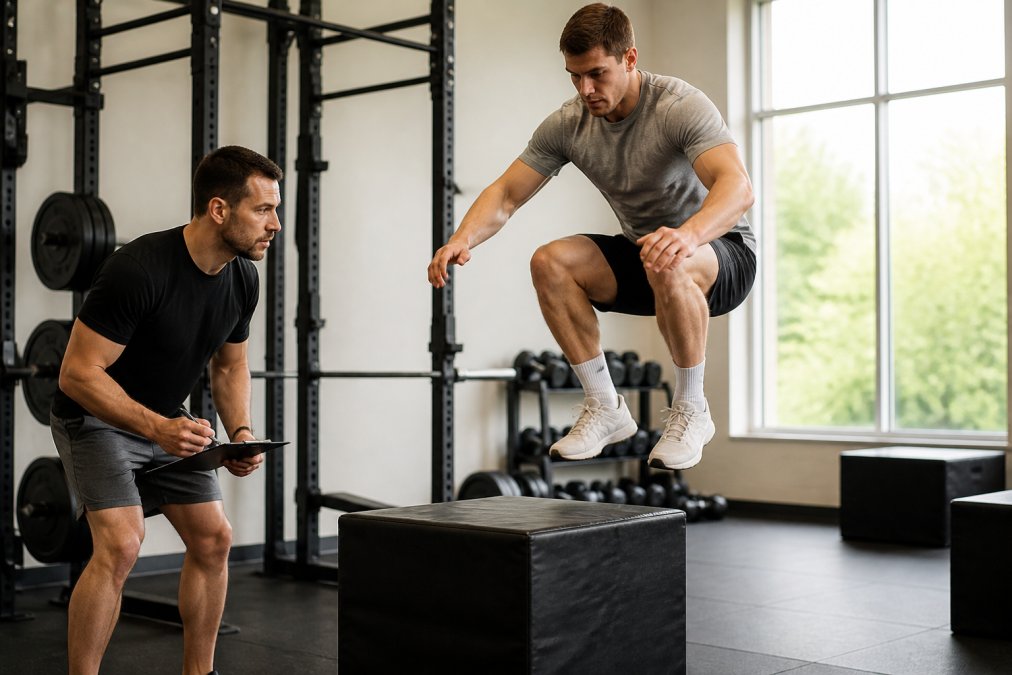
Athlete performing a box jump for power training while a coach monitors progress in a bright gym. -
Medicine ball throws, 3-5 sets of 3-5 throws. Overhead backward throws and rotational throws cover upper-body and torso power. Use a ball heavy enough that you feel the intent to accelerate, light enough that you don't slow down to control it.
-
Kettlebell swings, 4-6 sets of 8-12 reps with a hard-style hip snap. This is the one movement on the list where you can push the rep range higher, because the ballistic hip hinge self-limits velocity less than a jump does.
-
Jump squats, 3-5 sets of 3-5 reps at bodyweight or light load (10-20% of back squat). Land softly, reset, and treat every rep as a max-intent rep.
-
Broad jumps, 3-5 sets of 3-5 reps. Horizontal power and landing mechanics in one movement. Measure your distance so you have a baseline.
-
Pogo hops, 3-4 sets of 10-15 contacts. Low amplitude, stiff ankles, minimal knee bend. This is the entry point for reactive work and the safest way to introduce ground contacts.
-
Rest fully between sets. Power is an alactic quality. If you're breathing hard, you're training conditioning, not power. Two to three minutes minimum on loaded work, 60-90 seconds on low-level plyometrics.
-
Stop the set when velocity drops. If your fifth rep is visibly slower than your first, you've left the power zone. Cut the set short rather than grinding out junk reps.
-
Progress one variable at a time. Height, load, or complexity, never all three in the same week.
-
Keep total session volume low. For jumps and throws, 30-60 total ground contacts or throws per session is a reasonable ceiling for most trained people. Beginners should stay at the low end.
Training at home without a trap bar or medicine ball? Bodyweight and band-resisted versions still work. The mechanism is the same: intent to accelerate, full recovery, low volume. Only the load ceiling changes.
Power Training for Beginners: Where to Start Without Getting Hurt
Beginners should build a strength base first, then add low-complexity power work. Jumping into depth jumps in week one is how people get hurt, and copying an advanced athlete's program ignores that your tendons, connective tissue, and movement patterns need time to adapt.
Start here:
- Master a bodyweight squat and hip hinge with clean form
- Add low-level jumps (pogo hops, small box jumps) twice a week
- Keep total explosive volume low, roughly 30-40 ground contacts per session
- Progress load or height only when every rep looks identical
- Give yourself 48 hours between power sessions
Your Power Training Workout Schedule: How to Fit It Into a Real Week
A power training workout schedule works best when power comes first in a session, while you're fresh. Fatigue kills velocity, and slow reps don't train power.
| Day | Focus | Power Work | Strength Work |
|---|---|---|---|
| Monday | Lower power + strength | Box jumps, trap bar jumps | Squat variation |
| Wednesday | Upper power + pull | Med ball throws | Press, row |
| Friday | Full-body power | Kettlebell swings, broad jumps | Deadlift variation |
How to Measure Progress in a Power Training Program
Here's what that looks like in practice:
-
Bar velocity on a standard lift. If you're doing trap bar jumps or jump squats, a VBT device gives you a meters-per-second reading on every rep. When velocity drops below a threshold you set, commonly around 10% below your fastest rep of the day, you stop the set. This is the single most useful application of the technology for non-elite athletes.
-
Jump metrics from wearables. Many modern watches, rings, and chest straps estimate vertical jump height, ground contact time, and sometimes a composite power score. These are directional, not lab-grade, useful for spotting trends across weeks, not for comparing yourself to strangers.
-
Smartphone apps. Camera-based apps estimate bar velocity or jump height without dedicated hardware. Accuracy varies, but for tracking your own trend line, consistency matters more than absolute precision.
-
Vertical jump height for lower-body peak power
-
Broad jump distance for horizontal power and force application
-
Medicine ball throw distance for upper-body rate of development
-
Bar velocity on a standard lift if you have access to a velocity device
-
Ground contact time on plyometrics if your wearable tracks it, shorter contact time at the same jump height is a real power gain
A few practical cautions:
- Don't let the device become the program. The number is feedback, not a training method. Chasing a velocity target at the expense of clean technique inverts the priority.
- Test the same way each time. Same surface, same warm-up, same time of day if possible. Otherwise you're measuring noise.
- Treat consumer wearable numbers as trends, not truths. Optical heart rate and jump estimation have real error margins. A single reading means little; a four-week direction means a lot.
- Keep a simple log. Write down the number and how the rep felt, the felt sense and the data together tell you more than either alone.
Training at home without any tech? The field tests alone are enough. Vertical jump, broad jump, and a medicine ball throw, tested the same way every four to six weeks, will tell you whether your power training is moving the needle.
Power Training at Home, at Any Age, and With Wearable Tech
You don't need a barbell to train power, and you don't need to be young. Bodyweight jumps, medicine ball throws, and band-resisted movements cover most of what you need at home.
Home-based options that work:
- Step-ups performed explosively on a sturdy box or stair
- Medicine ball slams if you have a ball and a safe wall
- Band-resisted squat jumps for scalable load
- Fast bodyweight squats for rate of development
Common Mistakes That Stall Power Development
The biggest power training mistake is training power while fatigued. Power is a nervous-system quality, and a tired nervous system produces slow, weak reps that teach nothing useful.
Other frequent errors:
- Chasing soreness instead of tracking velocity and jump metrics
- Adding volume when progress stalls, instead of adding recovery
- Skipping the strength base and jumping straight to advanced plyometrics
- Ignoring landing mechanics, which builds power on a foundation of bad positions
- Testing too often, which turns measurement into another training stress
Frequently Asked Questions
How does power training differ from traditional strength training?
Traditional strength training builds how much force you can produce, often measured by a one-rep max. Power training programs train how fast you can produce that force, which is why they use lighter loads moved at high velocity, jumps, throws, and Olympic lifting variations. A heavy squat builds the strength base; a jump squat converts it into usable power for sprinting, jumping, and changing direction. Most athletes need both, sequenced correctly across a training week.
How often should I incorporate power training into my weekly routine?
Two to three sessions per week works for most people, placed before heavy strength work or on separate days. Power output drops fast when you are fatigued, so quality matters more than volume. A typical power training workout schedule might put explosive work on Monday and Thursday, with strength and conditioning on other days. Beginners should start with one session weekly for three to four weeks before adding a second.
What are the safety considerations for beginners starting power training?
Master bodyweight movements first: squats, hinges, pushes, pulls, and jumps landing softly. Add load only when landing mechanics look controlled. Warm up for 10 to 15 minutes, keep repetitions low (three to five per set), and stop a set when speed drops noticeably. If you have a previous injury, such as an old shoulder issue, get a qualified coach to review your movement before adding explosive work.
How do you measure progress in a power training program?
Track output, not just how you feel. Common measures include vertical jump height, broad jump distance, medicine ball throw distance, and bar velocity if you have access to velocity-based training tools. Retest every four to six weeks under the same conditions. Small, consistent gains in jump distance or throw distance usually show up before visible physique changes, which is why testing matters.
Can I build power at home without specialized equipment?
Yes. Jump squats, broad jumps, pogo hops, push-up variations with a clap, and medicine ball throws against a wall cover most of the training effect. A single kettlebell or a loaded backpack adds resistance for swings and throws. The key is intent: every repetition should be maximal effort with full recovery between sets. Home-based power training works well when you keep volume low and quality high.
Is power training safe for older adults?
Power training for longevity is one of the most underused tools for aging populations. Research on rate of force development shows that explosive capacity declines faster than raw strength with age, and that decline links to fall risk and loss of independence. Start with fast walks, step-ups performed quickly, and low-intensity medicine ball throws. Progress gradually, and get medical clearance if you have joint or heart conditions.
What is the 3-3-3 rule for strength training?
The 3-3-3 rule is a simple framework: three sessions per week, three exercises per session, three sets per exercise. It works as a starting structure for beginners who need consistency before complexity. Once that habit holds, you can layer in power work: three explosive exercises done for three to five reps before your main strength lifts. Simple structures beat elaborate ones when you are building a routine.
Why work with a coach instead of following a free program?
Free programs cannot see your shoulder flare up, your schedule, or how your speed drops in set four. A coach adjusts load, volume, and exercise selection week to week based on how you respond. Doug Briggs Strength builds programs around your goals, injury history, and available training days, with 30+ years of coaching experience behind every adjustment. Pricing depends on the format, so book a free consultation for current options.